Compostable Bags in America: BPI Is the Floor
- Share
Compostable Bags in America:
BPI Is the Floor. Here Is What Actually Closes Deals
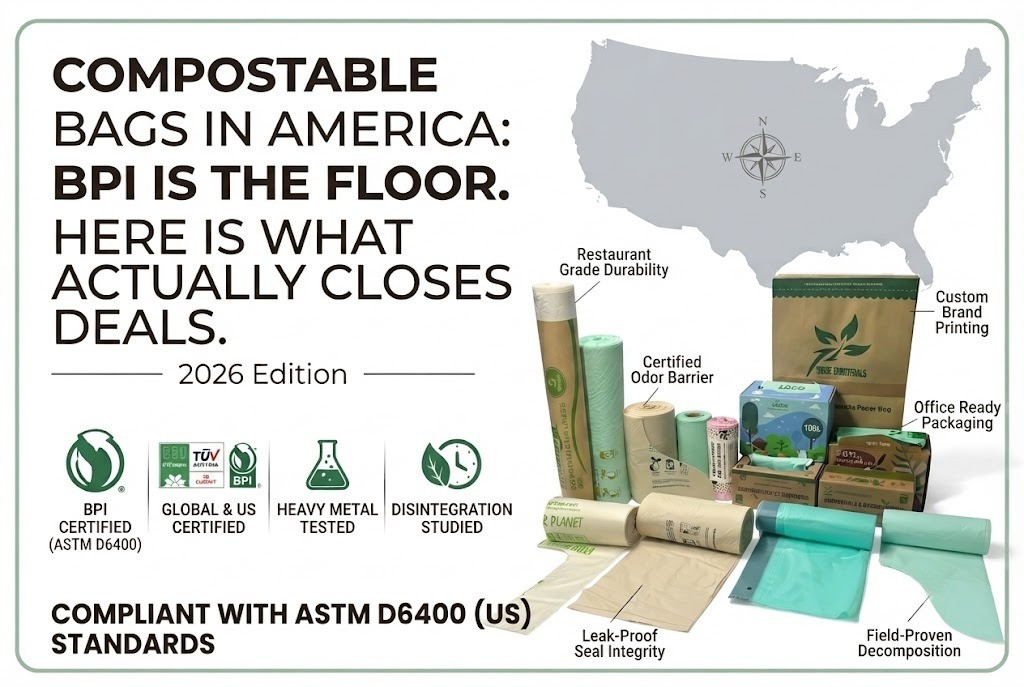
BPI Is the Floor, Not the Ceiling
Here is a sentence that sounds responsible and is actually incomplete: "Our bags are BPI certified."
BPI certification — the Biodegradable Products Institute's mark, based on ASTM D6400 — is the baseline every US buyer expects. If you do not have it, do not bother sending samples. But if you only have it, your RFQ response is incomplete.
BPI verifies that a product biodegrades under lab-simulated industrial composting: 58°C, controlled moisture, 180 days — in a bioreactor, not a windrow in Ohio in February. A growing number of US municipalities — starting with Ann Arbor, Michigan in 2024 — now require CMA field disintegration testing in addition to BPI, because they have seen BPI-certified products fail in their actual composting operations.
Then there is the regulatory layer. California's SB 54 — approved May 1, 2026, with a June 1 producer registration deadline — requires all single-use packaging to be recyclable or compostable by 2032. Certified compostable products pay lower EPR fees. The FTC Green Guides are not statutes, but the FTC enforces them: in 2017, they fined ECM BioFilms for unqualified "biodegradable" claims.
The US market in 2026 operates at the intersection of lab certification (BPI/ASTM), field verification (CMA), and regulatory compliance (FTC + state laws). A supplier who treats certification as a checkbox — "we have BPI, we're done" — is leaving gaps a procurement manager at Walmart, Kroger, or a municipal purchasing department will find.
The Enforcement Landscape: Patchwork, Not Policy
The FTC Has Already Fined People for This
The FTC Green Guides (16 CFR Part 260) establish that "compostable" is a substantiated claim. Section 260.7 requires competent scientific evidence; the FTC recognizes BPI as the accepted standard. But most suppliers miss the second requirement: qualification. If a product is only industrial compostable, you must clearly disclose that. Saying just "compostable" without specifying the environment is deceptive. The ECM BioFilms settlement (2017) established the FTC will pursue this.
CA California SB 54: The Law That Changes Everything
Approved May 1, 2026. Producers of single-use packaging were required to register by June 1, 2026 — joining the Circular Action Alliance (CAA) or complying independently through CalRecycle. 2032 targets: 25% less single-use plastic, 65% recycling rate, 100% recyclable or compostable. EPR fees are lower for certified compostable materials. CalRecycle can impose penalties up to $50,000 per violation per day. SB 343's labeling rules prohibit "compostable" on products not meeting ASTM D6400/D6868 — effectively making BPI a legal prerequisite in California.
The PFAS Overlay: 12 States and Counting
California, New York, Washington, Minnesota, Connecticut, Vermont, and six others restrict PFAS in food-contact packaging. BPI's 2020 PFAS ban (no intentionally-added fluorinated chemicals, total organic fluorine <100 ppm) means a current BPI-certified product inherently satisfies state PFAS requirements — but only if the certification is current.
The Three Credentials US Buyers Are Asking For
US BPI Certification: The Database Gap
Procurement managers do not open your certificate PDF. They go to bpiworld.org, type the product name, and check the listing. No listing = not certified. The database is the certification; the PDF is just a receipt. Before sending anything: is the listing live? Does the SKU match? Is the certificate within its 3-year window? Is the BPI logo on the actual bag? BPI launched a Home Compostability Program in 2025 based on NF T 51-800.
US CMA Field Testing: The Composter Revolt
CMA was founded by composting facility operators tired of accepting BPI-certified products that survived intact through actual windrow cycles. Products must pass ASTM lab testing, then undergo field disintegration testing at an operating facility through a full processing cycle (8-12 weeks). CMA-W (windrow) is the most relevant for the US market. The Ann Arbor effect: since 2024, the city requires CMA-W in addition to BPI. Other municipalities are following. Canada's Compost Council is building a Canadian CMA program.
US ASTM D6400/D6868: The Thickness Problem
ASTM D6400 certification is thickness-specific. A 1.0-mil certificate does not cover a 1.5-mil bag. This is the #1 reason suppliers get caught in procurement audits. D6868 applies to coated paper/fiber — sending a D6400 certificate for a D6868 product is technically incorrect.
What Actually Gets a PO Signed
US procurement managers start with the buyer's specific facility or customer: a municipal officer in Michigan asks about CMA-W. A produce distributor in California asks about SB 54. A national retail chain checks on-product BPI logo placement. What a prepared supplier sends before the first call:
- BPI certificate PDF — live, not expired. Verified against bpiworld.org. Product name, SKU, thickness must match.
- ASTM D6400/D6868 full test reports. Biodegradation curves, disintegration docs, heavy metals, ecotoxicity.
- PFAS compliance lab report. Total organic fluorine <100 ppm.
- CMA certification (if applicable). Verify CMA-W/CMA-ASP status before quoting for municipal buyers.
- On-product BPI logo photo. The actual printed bag, not a catalog image.
- Quality management system. ISO 9001, BRCGS, or equivalent.
- Resin chain of custody. Certification may be invalidated if resin formulation changes.
Three Suppliers, Three Outcomes
Supplier A sends a BPI certificate for a 1.0-mil bag. The buyer's QA measures the shipment at 1.3 mils. The certificate does not cover the thicker gauge. The PO is canceled. $22,000 in custom print tooling costs, lost.
Supplier B has a current BPI certificate matching the quoted SKU. Listing verified on bpiworld.org. Provides ASTM reports, PFAS docs, ISO 9001, pre-registered through CAA for SB 54. PO executes in the second evaluation round.
Supplier C sells to a municipal program requiring CMA-W. Only has BPI, claims CMA is "in progress" — 8 months out. Municipality cannot wait. Contract goes to a competitor with both credentials. The pattern: US procurement failures almost never happen because a supplier lacks any certification. They happen because the certification does not match the buyer's specific system.
The 2026-2030 Horizon
- FTC Green Guides revision — 2026-2027. Higher substantiation standards expected.
- California SB 54 full implementation — January 2027. Producer fees. First enforcement actions late 2027.
- CMA adoption spreading. Municipalities in Washington, Oregon, Northeast evaluating dual-certification.
- BPI Home Compostability scaling. Growing procurement relevance as backyard demand increases.
- PFAS expansion. 12 states now; federal EPA action possible but unlikely before 2028.
- Canada alignment. Field testing plus third-party certification required under pending rules.