Compostable Bags in Europe After PPWR
- Share
Compostable Bags in Europe After PPWR: What Certifications Really Mean After August 2026
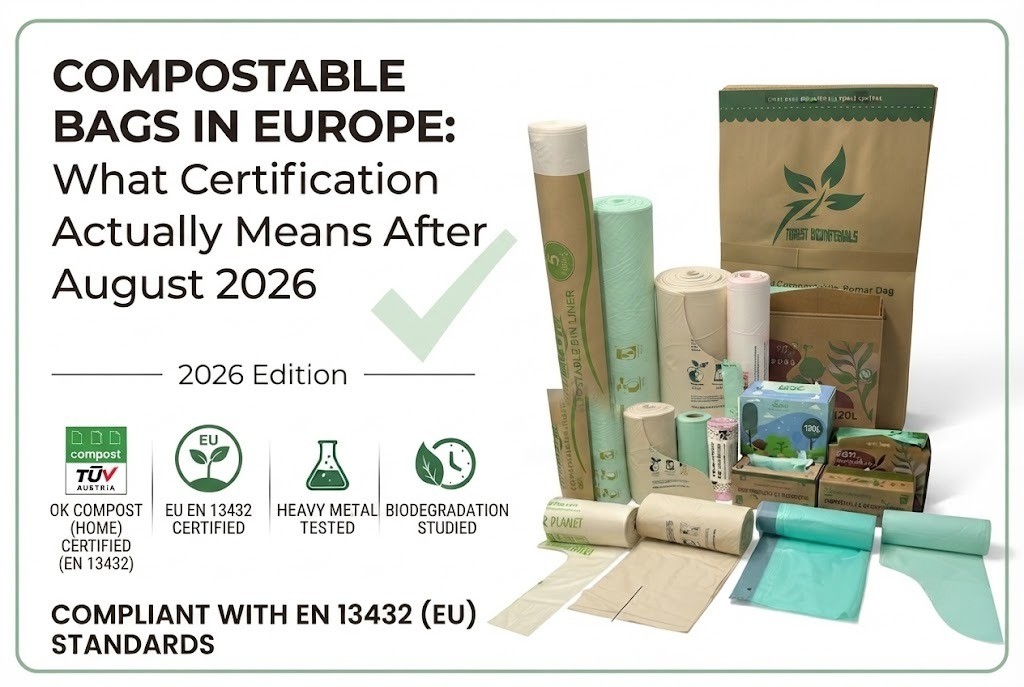
August 2026: The Deadline Nobody Is Ready For
On August 12, 2026, the European Union flips a switch. The Packaging and Packaging Waste Regulation — PPWR 2025/40 — enters enforcement. Unlike the 30-year-old directive it replaces, this is a regulation. Directives let member states interpret; regulations do not. From August 12, every piece of packaging entering the EU market faces the same rules with the same teeth.
If you sell compostable bags in Europe, this is not something you delegate to your distributor. PPWR assigns liability to every economic operator in the chain. The manufacturer. The importer. The distributor. The online marketplace. If your bags are on a shelf in Berlin or in an Amazon FBA warehouse in Poland, someone in your supply chain needs to prove they comply.
Most suppliers get this wrong: they think "EN 13432 certified" is the answer. It is part of the answer. But PPWR adds layers that EN 13432 alone does not cover — PFAS limits, EPR registration, and national rules in France, Germany, and Italy that override the EU baseline.
The three things European buyers will ask you to prove, starting August 2026:
1. That your product passes EN 13432 with a valid, in-date certificate from a recognized body.
2. That it meets PPWR PFAS limits — lab report, not a supplier letter.
3. That EPR registration exists in every member state where the bags are sold.
The PPWR Compliance Chain
PPWR is not a compostable-packaging law. It is a packaging law — every material, every format. But three articles directly reshape what "compostable" means in practice.
PFAS: The Immediate Fight — August 12, 2026
Food-contact packaging containing PFAS above these thresholds is banned: ≤25 ppb for any single PFAS compound, ≤250 ppb for total PFAS, or ≤50 ppm total fluorine. The European Commission's March 2026 implementation guide clarified the protocol: test total fluorine first. Pass (≤50 ppm) and you are done.
This hits compostable bag suppliers harder than most realize. PFAS has appeared — sometimes unintentionally — in bioplastic formulations, recycled-content resins, and processing aids. If your bag touches food — directly or as a food-waste liner — PPWR's PFAS limits apply.
EPR Registration: One Country ≠ All Countries
There is no single EU-wide EPR registration. Germany requires LUCID (ZSVR). France requires CITEO with a unique identifier on packaging. Italy, Spain, the Netherlands — each has its own system. Amazon EU has begun requiring sellers to upload national EPR numbers; listings without them face restriction. For compostable bag suppliers, certified compostable packaging qualifies for reduced EPR fees — typically 30-50% — but requires proof.
Compostable as a Recycling Track
Article 6 requires all packaging to be recyclable by 2030 (≥70%, Grade C). But certified compostable packaging meeting EN 13432 is recognized as an organic-recycling compliance track — confirmed by the PPWR FAQ (March 2026). Article 9 goes further: by February 2028, tea bags, coffee pods, and fruit/vegetable labels must be compostable.
Three Countries, Three Rulebooks
PPWR provides the floor. Individual member states have been adding walls.
FR France: Loi AGEC & NF T 51-800
Since January 2024, all bio-waste collection bags sold in France must meet NF T 51-800 — the French home-compostability standard. EN 13432 alone is not sufficient. NF T 51-800 requires ≥90% biodegradation at ≤30°C within 12 months, plant germination and earthworm survival tests, no endocrine disruptors, no CMR substances. Additionally, AGEC requires EPR registration through CITEO with a unique identifier. French distributors will ask for both — no CITEO number, no PO.
DE Germany: VerpackG & DIN-Geprüft
Compostable bags in Germany must carry DIN-Geprüft or equivalent EN 13432-based certification. German wholesale buyers typically request the full test report chain — not just the certificate PDF. ZSVR registration through LUCID is mandatory. Non-compliance fines start at €2,000 and scale to €200,000. Amazon DE enforces LUCID registration.
IT Italy: Bio-Plastics Mandate
Italy has required EN 13432 compliance for fruit/vegetable packaging and bakery bags since 2018. Italian law adds a minimum bio-based content requirement (≥40% renewable raw material, verified by ASTM D6866 or EN 16640 carbon-14 testing). Italian buyers expect both the compostability certificate and the bio-based content analysis.
The Certification Stack: What Each Logo Actually Proves
EU EN 13432 — The Legal Minimum
The harmonized standard: ≥90% biodegradation in 180 days at 58±2°C, disintegration ≤10% >2mm within 12 weeks, ecotoxicity pass, heavy metals below 94/62/EC limits. What this gets you: Legal market access under PPWR, reduced EPR fees. What it does not: French bio-waste compliance (needs NF T 51-800), automatic German retail acceptance (may need DIN-Geprüft), home-compost labeling rights.
EU OK Compost (TÜV Austria)
INDUSTRIAL: EN 13432 plus field testing at an operating composting facility, annual surveillance. The certification Tesco, Lidl, Aldi, Carrefour look for. HOME: ≥90% biodegradation within 12 months at ~25°C. The harder test. A product with HOME automatically meets industrial standards; the reverse is not true. PPWR labeling rules (2028) will make HOME the de facto requirement for consumer-facing claims.
EU Seedling Logo & DIN-Geprüft
Two marks, one certifier (DIN CERTCO). DIN-Geprüft dominates German-speaking markets. The Seedling logo is the most consumer-facing mark in Europe. Procuring both on a single DIN CERTCO certificate covers the full European retail landscape.
FR NF T 51-800 — The French Lock
Legal requirement for bio-waste collection bags under Loi AGEC. ≥90% biodegradation at ≤30°C within 12 months, earthworm survival test, no endocrine disruptors or CMR substances. In practice, OK Compost HOME and NF T 51-800 are considered functionally equivalent by French enforcement.
UK: The Post-Brexit Detour
Post-Brexit, the UK runs its own certification through Renewable Energy Assurance Limited (REAL). Standard base: BS EN 13432 / BS EN 14995. For home compostable products, REAL references NF T 51-800 and AS 5810. If you ship into UK retail (Tesco, Sainsbury's, Co-op, Waitrose), REAL certification is what the compliance team will request — often alongside rather than instead of EU marks.
What to Actually Send When a Buyer Says "Show Me Your Certs"
European B2B buyers are more documentation-literate than their counterparts in most other markets. They know the difference between a certificate and a test report. When they ask for documentation, they expect all of the following:
- The finished-product certification certificate. Not the resin supplier's certificate. From DIN CERTCO, TÜV Austria, or equivalent, with product name, SKU, and thickness matching exactly.
- The full test report package. Biodegradation curves. Disintegration photos. Heavy metal analysis. Ecotoxicity results. PFAS total fluorine report where applicable.
- Proof of EPR registration. LUCID number for Germany. CITEO identifier for France. CONAI for Italy. Each country-specific, each verifiable in its national register.
- Certificate validity check. EN 13432-based certificates are valid for 3 years. An expired certificate is worse than no certificate.
- Database cross-reference. Verify the product is in the certifier's public register. No listing = insufficient.
- Quality management system certificate. ISO 9001, BRCGS, or equivalent.
What Happens If You Get It Wrong
PPWR penalties are statutory — up to 4% of annual turnover for serious violations. Beyond fines:
- Customs detention. From August 2026, packaging without a valid EU Declaration of Conformity can be held at borders.
- Platform delisting. Amazon EU enforces EPR registration. Non-compliant listings face restriction and FBA inventory interception.
- Buyer liability transfer. If your distributor is fined because your product lacked valid certification, they pass the cost upstream — chargebacks, contract penalties, delisting.