Why Compostable Bags Cost More? The Real Factors Behind Sustainable Packaging Pricing
- Share
- publisher
- Rachel
- Issue Time
- May 7,2026
Summary
Why Bulk Compostable Bags Pricing Cost More?The answer lies in three interconnected areas: raw material chemistry, certification & compliance systems, and manufacturing complexity.
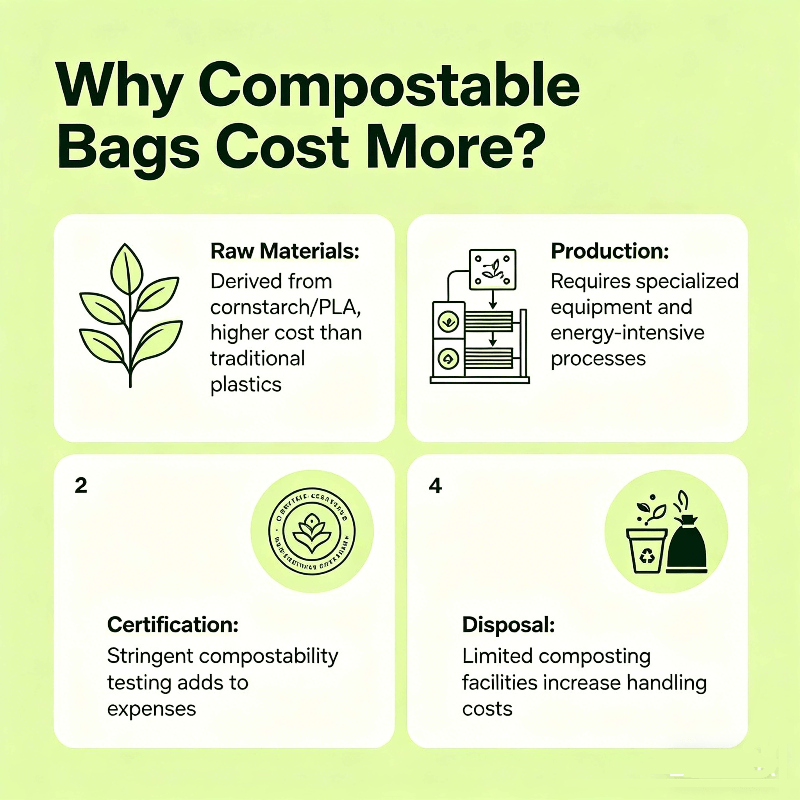
If you've compared conventional plastic bags with certified compostable alternatives, you've noticed the price gap. A standard polyethylene bag might cost $0.005 per unit, while a certified compostable bag can be two to three times higher. This leads many procurement professionals and brand owners to ask: why do compostable bags cost more, and is the premium justified?
The answer lies in three interconnected areas: raw material chemistry, certification & compliance systems, and manufacturing complexity. Below, we break down each cost driver so you can make informed sourcing decisions.
Raw material science: PLA, PBAT, and the recent price surge
Conventional plastic bags are made from fossil-based polyethylene (PE) or polypropylene (PP), produced on a massive scale with mature, low-cost supply chains. Compostable bags, by contrast, rely on specialty biopolymers such as PLA (polylactic acid) and PBAT (polybutylene adipate terephthalate), often blended with cornstarch or other plant components.
PLA production involves fermentation, polymerization, and purification — technologies with higher capital and energy requirements than polyolefin manufacturing. PBAT, although biodegradable, is more expensive to synthesize due to its complex co-polyester structure. These raw materials typically cost 2–3x more per ton than commodity resins. Moreover, supply scales for certified compostable polymers are still growing, limiting economies of scale compared to mature conventional plastics.
Recent price surge: Why are PLA and PBAT becoming more expensive?
Beginning in late March 2026, the compostable raw material market experienced significant upward price pressure. Several converging factors drove this trend:
- Geopolitical tensions in the Middle East: The escalating US-Iran conflict disrupted shipping routes through the Strait of Hormuz, a critical passage for global energy and petrochemical supplies. This triggered a sharp rise in crude oil prices, which directly impacts biodegradable material production, as 20–30% of raw material inputs are crude oil derivatives.
- Crude oil price shock: Global crude prices rose by approximately 20–30% in recent weeks, directly elevating production costs for PBAT and other bio-based polymers.
- Cost pass-through to finished materials: Manufacturers have been forced to adjust pricing. In Tamil Nadu, India, production costs for biodegradable bags increased from approximately Rs 127 to Rs 170 per kilogram, while market prices surged from Rs 150 to Rs 250 per kg.
Certification costs: EN13432, ASTM D6400, BPI and beyond
To claim "compostable" in global markets, products must undergo rigorous third-party testing and annual certification renewals. Each certification adds significant cost, which is embedded in the final bag price.
- ASTM D6400 (US) and EN 13432 (EU) require disintegration, biodegradation, and ecotoxicity tests using accredited labs — costing thousands per material formulation.
- BPI, TÜV OK compost, DIN CERTCO certifications involve initial audits, annual license fees, and batch testing.
- Home compostable certification (e.g., OK compost HOME) demands even stricter performance at ambient temperatures, increasing development and testing expenses.
In contrast, conventional PE bags require zero environmental certification. For a compostable bag manufacturer, these compliance costs are non-negotiable — and they ensure you avoid greenwashing litigation and gain access to regulated markets (EU, California, Australia).
Manufacturing & performance engineering
Producing a reliable compostable bag requires precision compounding and film extrusion. Biopolymers are more sensitive to temperature, humidity, and processing conditions than polyolefins. Manufacturers must invest in:
- Dedicated extrusion lines to avoid cross-contamination with conventional plastics.
- Tighter quality control for thickness uniformity and seal strength (leak-proof requirements).
- Water-based printing systems instead of solvent-based inks, which are more expensive but eco-friendly and compliant.
- Additive stabilization to ensure the bag maintains mechanical properties during storage (compostable bags have a shelf life of 6–12 months).
These factors increase production costs by roughly 20-40% compared to standard plastic bag production. Additionally, drawstring, ziplock, or scented options require extra material and assembly steps, further raising the unit price.
Volume, MOQ, and customization economics
Conventional bags are made in billions of units, allowing extreme cost reduction. Compostable bags, while growing, still have lower production volumes, particularly for custom orders (specific thickness, size, pantone colors, or printed branding). Minimum order quantities (MOQ) for custom certified bags often start from 100,000 to 300,000 pieces, whereas PE bags can be sourced at lower MOQs.
Moreover, features like water-based flexo printing (up to 4 colors) and drawstring closures add 10-20% more than a standard flat bag. However, these premium attributes enable higher retail pricing and strengthen your brand's sustainable story.
Cost comparison: conventional vs. certified compostable bag
| Cost factor | Standard PE bag | Certified compostable bag |
|---|---|---|
| Raw material (per ton) | ~$1000–1300 | ~$2400–3200 (PLA/PBAT blend) |
| Certifications | None | EN13432, BPI, OK compost (adds $0.003–0.01 per bag) |
| Production complexity | Mature, high-speed lines | Specialized line, narrower process window |
| Printing | Solvent-based (low cost) | Water-based inks, higher cost & compliance |
| Shelf life | 3+ years | 12 months (requires controlled storage) |
| End-of-life impact | Microplastics, centuries | Compostable, circular nutrient return |
Shipping & storage considerations
Compostable bags require protection from heat and humidity during shipping and warehousing. PLA-based films start to soften above 50°C, meaning containers may need climate control during summer months. This adds a small logistics premium (2-5%) compared to PE bags. Responsible suppliers pre-test storage conditions and provide technical guidelines to ensure product integrity.
Value beyond price: why the extra cost makes sense for B2B brands
While the upfront cost is higher, compostable bags deliver significant value:
- Regulatory readiness: With single-use plastic bans expanding (EU, Canada, Australia, US states like California), switching early future-proofs your supply chain.
- Brand premium & consumer trust: 73% of pet owners prefer eco-friendly poop bags and are willing to pay more for certified compostable options.
- Risk reduction: Genuine certification shields you from greenwashing lawsuits and retail exclusion.
- Circular economy alignment: Compostable bags enable organic waste diversion, supporting corporate net-zero goals.
Final thoughts: bridging the investment gap
The cost gap between compostable and conventional plastic bags reflects real differences in material technology, certification rigor, and responsible manufacturing. As global capacity for biopolymers expands, prices are expected to decline — but even today, the premium pays for verifiable sustainability and compliance.
For B2B buyers, the smart approach is to evaluate total cost of ownership: include certification, branding benefits, and regulatory security. Request verified test reports (EN13432, ASTM D6400, BPI) and always run pre-production samples to ensure thickness, seal strength, and compostability performance.
Looking for reliable custom compostable bags?
Torise Biomaterials provides certified compostable bags, drawstring options, and custom branding with full BPI / EN13432 documentation. Request samples and see how we bridge quality and value.