Will Compostable Bags Degrade During Shipping or on the Shelf?
- Share
- publisher
- Rachel
- Issue Time
- Sep 15,2026
Summary
A common question from buyers sourcing compostable bags is: “If a bag is compostable, will it start breaking down during international shipping or while sitting on a warehouse or retail shelf?”
Compostable Packaging Guide
A common question from buyers sourcing compostable bags is:
“If a bag is compostable, will it start breaking down during international shipping or while sitting on a warehouse or retail shelf?”
Normally, no.
A compostable bag is not designed to spontaneously biodegrade under normal transportation and storage conditions. Its compostability refers to what happens under appropriate end-of-life conditions, not what should happen during its intended service life.
The key is to distinguish between service life and end-of-life biodegradation.
During transportation, warehousing and normal use, a compostable bag is expected to maintain the properties required for its application.
Depending on the product, these may include:
After disposal into an appropriate composting environment, however, the conditions are very different.
Higher temperatures, moisture, oxygen and microbial activity can create conditions that promote the degradation and biodegradation of compostable materials.
This balance is an important part of compostable packaging design.
Shelf-life stability is not determined by compostability certification alone. Several factors can influence how a compostable bag performs during storage and transportation.
For this reason, buyers should not evaluate a compostable bag only by asking whether it has a compostability certificate.
For a commercial packaging program, the more practical questions are:
What is the expected shelf life before use? What storage conditions are recommended? How should the bags be packaged for international transportation? How sensitive is the product to heat and moisture? How does mechanical performance change after extended storage? Is the finished bag suitable for the intended application and service period?
These questions are particularly relevant when products are manufactured in one country and then transported by sea to another market, followed by additional warehousing before reaching the end user.
The balance between storage stability and compostability starts with material formulation.
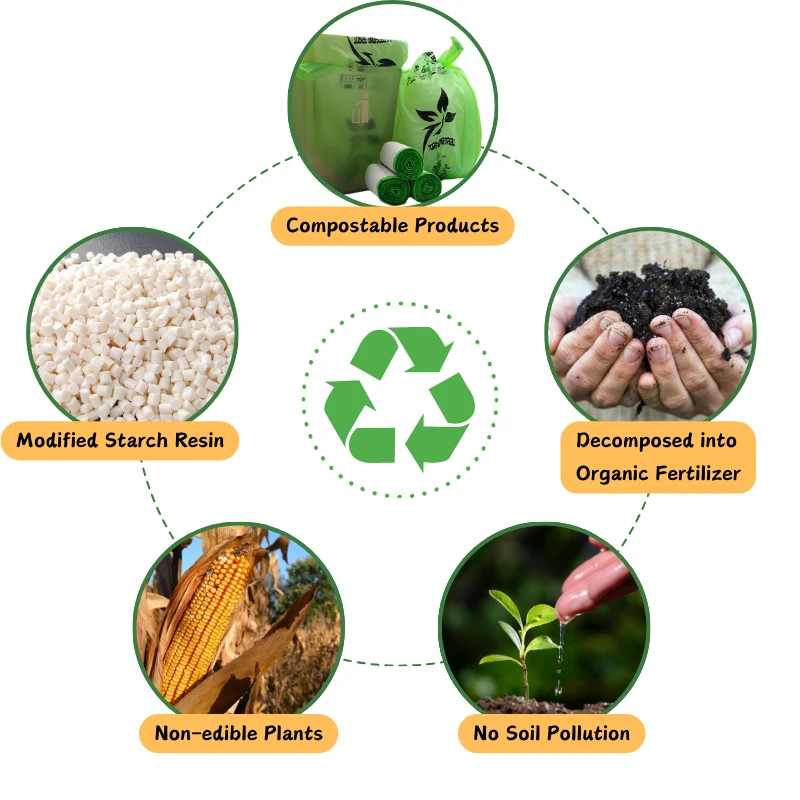
Compostable bags can be produced using different compostable polymer systems. Depending on the required properties and application, materials such as PBAT, PLA and starch-based components can be formulated and adjusted to achieve an appropriate balance of flexibility, strength, sealing performance and compostability.
The exact formulation matters because different materials contribute different characteristics.
For example, a bag used for food storage may require a different balance of flexibility and sealing performance from a compostable produce bag or another thin-film application.
The objective is therefore not simply to select a polymer that is labeled “compostable.”
It is to develop a material system that can provide the required performance during use while still meeting the applicable compostability requirements after disposal.
Material formulation is only the first stage.
Once the formulation has been selected, film production can affect the properties of the finished material. Factors such as:
all contribute to the performance of the final packaging product.
A compostable bag should therefore be evaluated as a finished packaging product, rather than assuming that the properties of one polymer automatically represent the performance of the finished bag.
For B2B buyers, this distinction is important.
The material may have suitable compostability characteristics, but the finished bag still needs to maintain the mechanical and functional properties required by the application.
International transportation can expose packaging materials to conditions that are very different from controlled warehouse storage.
Depending on the route and season, containers and warehouses may experience elevated temperatures and significant humidity. Long transportation times can increase the importance of appropriate packaging protection and storage practices.
For compostable bags, it is therefore important to consider:
Protective outer packaging can help reduce unnecessary exposure to humidity and other environmental factors. Recommended storage conditions should also be considered when planning inventory and distribution.
This is especially important for B2B buyers purchasing large quantities and holding stock before converting, distributing or selling the products.
The purpose of controlling stability during storage is not to make compostable packaging permanently resistant to degradation.
The objective is more precise.
A compostable bag should remain sufficiently stable under its intended storage and application conditions, while being capable of biodegrading under the appropriate composting conditions defined by the applicable requirements.
Composting conditions can involve combinations of:
These conditions are substantially different from those normally encountered during shipping or retail storage.
This is why compostability should always be understood in relation to the conditions and standard under which it is evaluated.
A certification or test result does not mean that the product will behave the same way in every environment.
For procurement teams, a compostable bag should be evaluated from more than one perspective.
A practical assessment should consider the complete product chain:
Each stage can affect the final performance of the product.
This is also why a compostable material should not be selected simply because it has a biodegradable or compostable label. The material system, film structure, bag construction, intended service life and end-of-life requirements all need to work together.
For example, a bag intended for a short-term food packaging application may have different performance requirements from one that needs to remain in storage for an extended period before use.
The right question is therefore not:
“How quickly does this compostable bag degrade?”
A more useful B2B question is:
“How long will the bag maintain the required performance under our actual storage and application conditions, and under what conditions is it designed to biodegrade after disposal?”
At Torise, we consider compostable bags as a complete product system rather than treating compostability as a property of a single polymer.
Our approach covers the chain from compostable raw materials to film production and finished bag converting.
Depending on the application, compostable polymer systems such as PBAT, PLA and starch-based components can be formulated to achieve the required balance of mechanical performance, flexibility, sealing properties and compostability.
We then consider the finished product, including film thickness, processing conditions, bag structure and sealing performance.
Storage and transportation are also part of the product planning process. Appropriate packaging configuration and storage recommendations help protect product quality during international transportation and warehousing.
Stable enough for its intended service life. Compostable under the appropriate end-of-life conditions.
That balance is what makes compostable packaging suitable for real-world B2B applications—not simply for laboratory compostability testing.
Will Compostable Bags Degrade During Shipping or on the Shelf?
Compostable Does Not Mean Unstable During Normal Storage
What Determines the Shelf Life of a Compostable Bag?
Factor
Why It Matters
Material formulation
Different polymers, blends and additives can affect flexibility, strength, moisture sensitivity and long-term stability.
Moisture exposure
Prolonged exposure to humidity can affect some compostable materials and may accelerate material changes.
Temperature
Extended exposure to elevated temperatures can influence polymer properties over time.
Packaging protection
Outer packaging can help reduce exposure to humidity and environmental conditions during transportation and storage.
Storage conditions
Temperature, humidity and direct sunlight can affect product stability.
Film thickness
Thickness influences mechanical performance and can affect how the finished bag behaves during storage and use.
Converting process
Film production and bag-making conditions can influence sealing and mechanical performance.
Material Design Is the Starting Point
Film Production Also Affects Product Stability
Transportation and Storage Need to Be Considered Too
What Happens After Disposal?
Compostability Is Only One Part of Product Performance
How We Approach Compostable Bag Development