Oxo-Degradable Plastic Bags vs. Compostable Bags: What Is the Difference?
- Share
- publisher
- Rachel
- Issue Time
- Sep 17,2026
Summary
If you are sourcing biodegradable or sustainable plastic bags, you may come across terms such as oxo-degradable, oxo-biodegradable, biodegradable, compostable, bio-based, and bioplastic. These terms are not interchangeable.
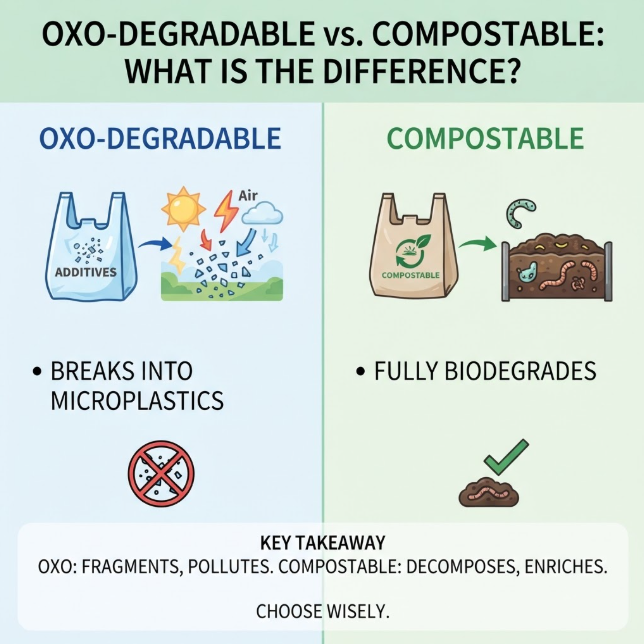
If you are sourcing biodegradable or sustainable plastic bags, you may come across terms such as
oxo-degradable, oxo-biodegradable,
biodegradable, compostable,
bio-based, and bioplastic.
These terms are not interchangeable.
In particular, oxo-degradable plastic bags and
certified compostable bags follow very different end-of-life concepts.
An oxo-degradable bag is conventional plastic modified with an additive that promotes
oxidation and fragmentation. A compostable bag, when properly certified, is designed and
tested to disintegrate and biodegrade under specified composting conditions.
For packaging buyers, this difference matters because the claim on a product specification
sheet can affect market access, certification, waste handling, labeling, and customer expectations.
The most important distinction is how the material is expected to behave at the end of its
useful life.
Oxo-degradable plastic is generally conventional petroleum-based plastic
containing an additive intended to accelerate oxidation when exposed to environmental
conditions such as heat, oxygen and light. The plastic can become brittle and fragment into
smaller pieces.
Compostable plastic, by contrast, is designed around a biological
end-of-life pathway. A certified compostable product is tested against defined requirements
for biodegradation, disintegration and effects on the composting process.
Therefore, a bag that becomes smaller or breaks apart is not automatically a compostable bag.
For packaging buyers, the key question is not simply whether a material disappears visually,
but what happens to the material and under which defined conditions.
“Compostable” is a more specific claim than simply saying that a plastic is biodegradable.
It refers to a material's ability to break down through biological processes under defined
composting conditions and within the requirements of a relevant standard.
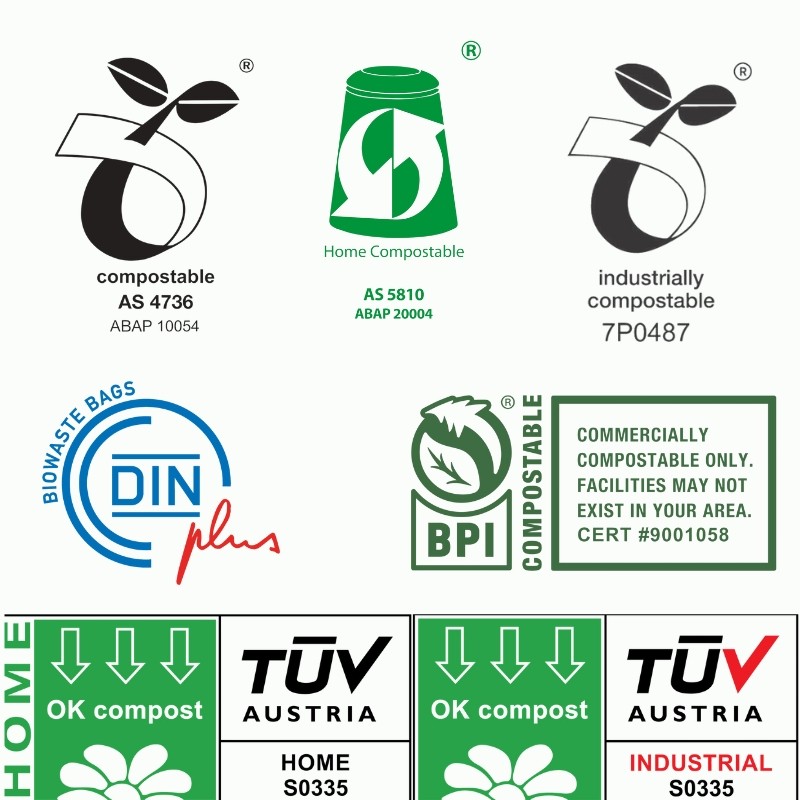
For packaging, EN 13432 is one of the major standards used to assess
industrially compostable packaging in Europe. It considers factors including biodegradation,
disintegration during composting, effects on the biological treatment process and the quality
of the resulting compost.
Other markets use their own certification and conformity systems. For example,
BPI certification is widely recognized in North America, while
DIN CERTCO provides certification schemes for compostable products and
materials.
This is why a serious compostable packaging specification should identify more than the word
“compostable”. Buyers should be able to determine which standard applies, what type
of composting environment is required, and whether the finished product has been assessed.
The difference becomes clearer when the two approaches are compared by their intended
end-of-life behavior.
The important point is that fragmentation is not the same as composting.
A packaging material should not be treated as compostable simply because it can become
physically smaller over time.
This is one of the most common points of confusion when comparing sustainable plastic
materials.
A plastic product can lose its original form without satisfying the requirements of a
compostability standard. From a packaging procurement perspective, visual disappearance is
therefore not a sufficient measure of environmental performance.
Certified compostability focuses on what happens to the material during a defined biological
treatment process. Depending on the certification, this can include requirements related to
biodegradation, disintegration, ecotoxicity and the quality of the resulting compost.
This distinction is particularly important for food packaging because the intended end-of-life
route may involve commercial composting facilities, organic waste collection systems or other
managed treatment infrastructure.
For B2B buyers, certification is more useful when it is connected to a specific market and
end-of-life requirement.
Depending on the application and destination market, relevant standards or certification
systems may include EN 13432, BPI, ASTM D6400 and DIN CERTCO.
The applicable requirement should always be confirmed for the target country, product category
and intended disposal route.
A supplier may also have certifications covering other aspects of its material and
manufacturing system. For example, FSC can be relevant to responsibly
sourced paper-based packaging, while ISCC PLUS can provide a framework for
certain certified material sourcing and mass-balance approaches.
These certifications should not be treated as interchangeable. Each one addresses a
particular material, sourcing, production or end-of-life characteristic.
When evaluating an oxo-degradable or compostable plastic bag, procurement teams should look
beyond the material name.
Ask whether the bag is conventional plastic with additives, a compostable polymer blend,
a bio-based material, or another formulation.
Resin-level claims are not necessarily the same as certification of the finished packaging.
Request documentation relevant to the actual bag specification.
Confirm whether the product is assessed under EN 13432, ASTM D6400, BPI, DIN CERTCO or
another applicable standard.
Industrially compostable does not automatically mean home compostable, and certification
does not guarantee acceptance by every local waste facility.
Local labeling, packaging and waste-management requirements can differ between countries
and regions.
There is no single packaging material that is automatically suitable for every market or
application.
A buyer may be comparing compostable produce bags, food storage bags, refuse bags, packaging
films or other flexible packaging products. The correct material depends on the required
mechanical performance, shelf life, food-contact requirements, certification, local
regulations and available end-of-life infrastructure.
This is why procurement decisions should begin with the intended application and target
market rather than with a generic label such as “biodegradable plastic”.
For companies selling into multiple countries, the same packaging specification may also
require different documentation or certification depending on where the product will be
marketed.
At Torise Group, we approach sustainable packaging from both the material
and market perspective.
Our product portfolio includes compostable packaging, recycled-content packaging and
paper-based packaging, allowing different material strategies to be considered according to
the application and target market.
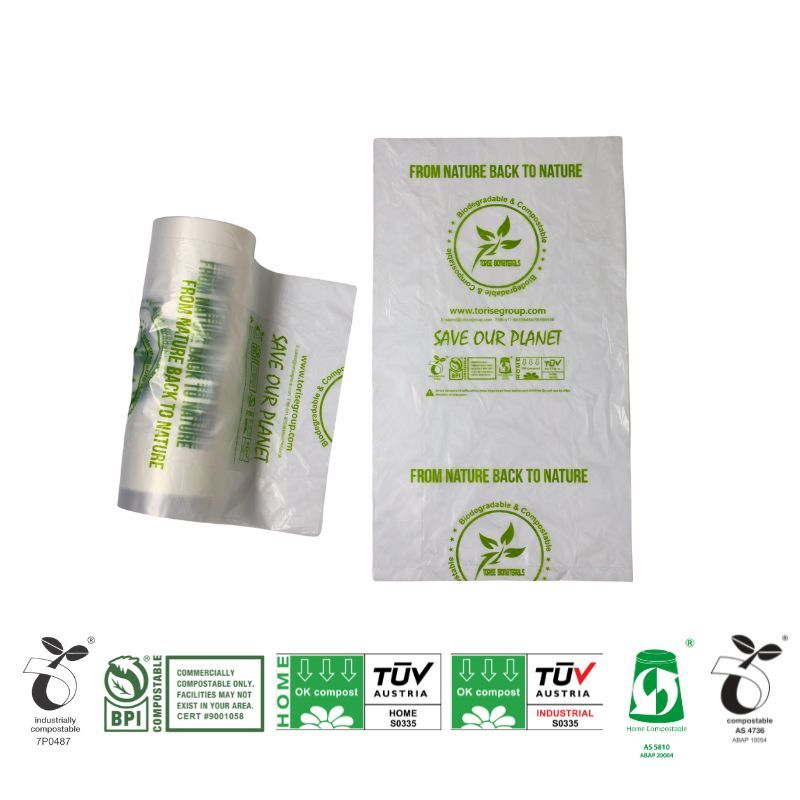
For compostable products, relevant certification and supporting documentation can include
systems such as EN 13432, BPI, TUV, DIN CERTCO and other market-specific
requirements, depending on the product and destination market.
For recycled-content materials, certifications such as GRS may be relevant,
while FSC can support responsible sourcing requirements for applicable
paper packaging. ISCC PLUS may also be relevant for certain certified
material sourcing and mass-balance applications.
The goal is not to use a sustainability label simply for marketing purposes. The more useful
approach is to match the material, certification, application, target market and
end-of-life pathway with the actual requirements of the buyer.
Oxo-degradable plastic and compostable plastic should not be treated as two names for the
same type of packaging.
Oxo-degradable plastic is based on oxidation and fragmentation of conventional plastic,
whereas certified compostable packaging is designed and evaluated for biodegradation and
disintegration under defined composting conditions.
For B2B buyers, the most useful question is therefore not simply
“Is this bag biodegradable?” but:
Understanding these differences makes it easier to compare suppliers, evaluate certification
documents and select packaging that is appropriate for the actual market rather than relying
on broad sustainability terminology.
Oxo-Degradable Plastic Bags vs. Compostable Bags: What Is the Difference?
Oxo-Degradable and Compostable Are Not the Same Thing
What Does Compostable Mean?
Oxo-Degradable vs. Compostable: The Key Difference
Factor
Oxo-Degradable Plastic
Compostable Plastic
Basic concept
Conventional plastic modified with an additive that promotes oxidation
Material designed for biodegradation and disintegration under specified composting conditions
End-of-life focus
Oxidation and fragmentation
Biological degradation under defined composting conditions
Certification approach
Not equivalent to compostability certification
Can be assessed against recognized compostability standards and certification schemes
Composting claim
Should not automatically be described as compostable
Claim should correspond to the applicable standard and certified end-of-life conditions
Buyer consideration
Material behavior and regulatory acceptance need careful review
Certification, intended composting environment and local disposal pathway should all be checked
Why “It Breaks Down” Does Not Mean “It Is Compostable”
Certification, Standards and Market Requirements
What Should B2B Buyers Check Before Ordering?
Choosing the Right Material for Your Market
Torise Group’s Approach to Sustainable Plastic Packaging
The Bottom Line