Navigating Global Packaging Regulations: How Torise Supports Businesses with Compliant Compostable Packaging Solutions
- Share
- publisher
- Rachel
- Issue Time
- Jun 24,2026
Summary
Prepare for EU PPWR 2026, SUPD, and US EPR laws. Discover compliant compostable packaging solutions that balance regulation, performance, and supply-chain scalability.
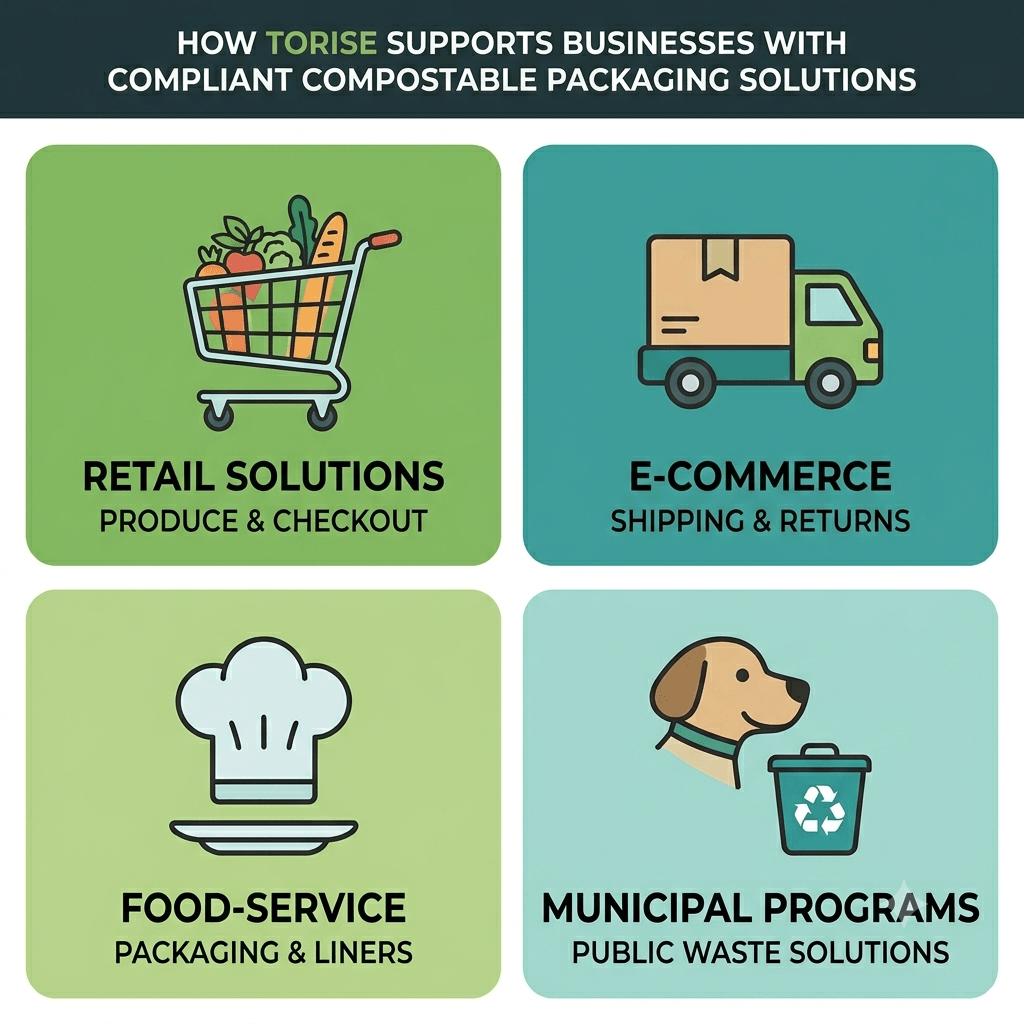
For many years, sustainable packaging was largely driven by consumer preferences, corporate ESG commitments, and brand positioning. Companies adopted environmentally friendly packaging primarily to strengthen their sustainability image and respond to growing consumer awareness. Today, the landscape is changing. Across Europe, North America, Australia, and parts of Asia-Pacific, governments are introducing increasingly stringent regulations targeting packaging waste, single-use plastics, producer responsibility, environmental claims, and end-of-life waste management. What was once considered a sustainability initiative is rapidly becoming a business requirement. For brands, retailers, distributors, importers, e-commerce sellers, food-service operators, and municipal programs, the question is no longer: "Should we consider sustainable packaging?" Instead, it has become: "How can we ensure our packaging remains compliant while maintaining performance, efficiency, and customer expectations?" As a result, compostable packaging is increasingly viewed not only as an environmental alternative, but also as a practical strategy for navigating evolving regulatory requirements across global markets. Although packaging regulations vary by region, most are moving in a similar direction. Governments worldwide are focusing on: These developments are reshaping procurement decisions throughout the packaging supply chain. Packaging is no longer evaluated solely on cost, appearance, and functionality. Increasingly, businesses must also consider compliance, certification requirements, waste-management infrastructure, and long-term sustainability objectives. For many organizations, packaging has become both a procurement decision and a compliance decision. The European Union remains one of the most influential regulatory regions in the world. Packaging policies introduced in Europe often influence procurement standards and sustainability expectations far beyond EU borders. The Single-Use Plastics Directive (SUPD) entered into force in 2019, with major restrictions becoming applicable from July 2021. The directive targets commonly littered single-use plastic products and introduces measures designed to reduce plastic pollution throughout the EU. Key implications include: For businesses selling into Europe, packaging materials and product claims are increasingly subject to regulatory review. The Packaging and Packaging Waste Regulation (PPWR) entered into force in February 2025 and will generally apply from August 2026. Unlike previous directives, PPWR creates a more harmonized regulatory framework across all EU Member States and applies to virtually all packaging placed on the European market. Key objectives include: For manufacturers, importers, retailers, and brand owners, packaging compliance is becoming increasingly tied to market access and retailer acceptance. Businesses that proactively evaluate packaging alternatives today are likely to be better prepared for future regulatory developments. Unlike Europe, packaging regulations in the United States are primarily implemented at the state level. Several states have introduced or expanded legislation related to: States such as California, Colorado, Oregon, Washington, and Minnesota are increasingly influencing packaging procurement decisions nationwide. For companies operating across multiple states, maintaining different packaging systems for different jurisdictions can create complexity and additional compliance risks. As a result, many businesses are evaluating packaging solutions that can support broader compliance objectives while maintaining operational efficiency. Although implementation timelines differ, these markets are moving in a similar direction. Both countries continue expanding restrictions on problematic plastic products while encouraging the adoption of certified compostable alternatives. Buyers increasingly seek packaging that aligns with recognized standards such as: These certifications are often requested by retailers, distributors, and sustainability-focused organizations. Canada continues advancing waste-reduction initiatives and expanding municipal organics collection programs. As composting infrastructure develops, demand for compostable packaging solutions is expected to increase across food service, retail, and municipal applications. Japan's sustainability transition is often driven by corporate procurement standards and waste-reduction objectives. In addition to environmental performance, Japanese buyers place strong emphasis on: Key Regulatory Milestones Shaping the Future of Compostable Packaging As governments strengthen packaging regulations worldwide, businesses should prepare for increasingly demanding compliance requirements. While regulations differ by market, the overall trend is remarkably consistent. For many organizations, waiting until regulations become mandatory may significantly increase future compliance costs and supply-chain risks. Retailers face increasing pressure from: Common priorities include replacing conventional plastic bags while maintaining usability, durability, and cost efficiency. Online sellers and logistics providers face growing scrutiny regarding packaging waste. Challenges include: Restaurants, food-service distributors, and delivery operators must balance: Packaging solutions increasingly need to support both operational efficiency and environmental objectives. Municipalities, environmental organizations, and public waste-management programs increasingly seek products that align with local composting infrastructure. Common applications include: These projects require solutions designed for real-world waste-management systems rather than marketing claims alone. Switching to compostable packaging is rarely as simple as replacing one material with another. Many organizations underestimate four major challenges. Different markets recognize different certification systems, including: Understanding which certifications apply to a target market is essential. Packaging must continue to deliver: Compliance should never come at the expense of functionality. Environmental claims are receiving increasing regulatory attention. Improper labeling or unsupported compostability claims may create compliance risks and damage brand credibility. A material that performs well during product testing may not always perform consistently at commercial scale. Long-term supply reliability and manufacturing consistency are increasingly important considerations. At Torise, compostable packaging is viewed as a complete compliance-oriented solution rather than a standalone product category. Our approach begins with understanding: This enables us to recommend solutions aligned with both regulatory requirements and commercial objectives. Torise supports retailers and grocery brands with: Designed to balance food-contact safety, durability, transparency, and compliance requirements. For e-commerce brands and fulfillment operations, Torise provides: Designed to support sustainability goals while maintaining shipping performance. For food-service operators and distributors, Torise offers: Suitable for demanding commercial environments. For municipalities and environmental organizations, Torise provides: Designed around real-world composting infrastructure and public-use requirements. A successful compostable packaging strategy involves more than selecting a material. Torise supports customers through a comprehensive development process. Matching compostable material systems to performance, certification, and end-of-life requirements. Optimizing thickness, strength, sealing performance, and durability. Supporting custom printing, retail-ready packaging, and private-label product lines. Supporting certification alignment, documentation requirements, and market-specific compliance objectives. As packaging regulations continue to evolve across Europe, North America, and Asia-Pacific, businesses are increasingly required to consider not only packaging performance, but also regulatory compliance, waste-management compatibility, and long-term sustainability objectives. For many organizations, selecting a compostable packaging solution is no longer simply a packaging decision. It is becoming part of a broader market-access, procurement, and risk-management strategy. Businesses that begin evaluating compliant packaging alternatives today are often better positioned to adapt to future regulatory changes while maintaining supply-chain stability, customer expectations, and competitive advantage.Navigating Global Packaging Regulations: How Torise Supports Businesses with Compliant Compostable Packaging Solutions
Why Compostable Packaging Is Becoming a Business Requirement Rather Than an Environmental Choice
Global Regulatory Trends Reshaping the Packaging Industry
European Union: The Global Benchmark for Packaging Regulations
Single-Use Plastics Directive (SUPD)
Packaging and Packaging Waste Regulation (PPWR)
United States: State-Level Regulations Driving Packaging Transformation
Australia, New Zealand, Canada, and Japan: Expanding Sustainability Expectations
Australia & New Zealand
Canada
Japan
2026–2030 Global Packaging Regulation Timeline
Year
Region
Regulation / Policy
Key Impact
2021
European Union
SUPD implementation begins
Restrictions on selected single-use plastic products
2025
European Union
PPWR enters into force
Establishes a unified packaging framework
Aug 2026
European Union
PPWR becomes generally applicable
Stronger packaging design and waste-reduction requirements
2025–2027
Multiple US States
Expansion of EPR legislation
Greater producer responsibility for packaging waste
2026–2030
California, Colorado, Oregon, Minnesota
Packaging reduction and recycling targets expand
Increased adoption of alternative packaging solutions
2025–2030
Australia
Continued expansion of plastic restrictions
Growing demand for certified compostable alternatives
2025–2030
New Zealand
Progressive plastic phase-out initiatives
Stronger sustainability requirements
2026–2030
Canada
Expansion of organics collection programs
More opportunities for compostable packaging
2026–2030
Japan
Increasing sustainability procurement requirements
Greater focus on environmentally responsible packaging
2026–2030
Global Brands & Retailers
Accelerating ESG and supply-chain requirements
Packaging compliance becomes a supplier qualification factor
What This Means for Packaging Buyers
How These Regulations Affect Different Industries
Retail & Grocery
E-commerce & Logistics
Food Service & Hospitality
Municipal & Public Programs
The Compliance Challenges Many Businesses Underestimate
Certification Requirements
Packaging Performance
Environmental Claims & Labeling
Supply-Chain Scalability
How Torise Supports Businesses with Compliant Compostable Packaging Solutions
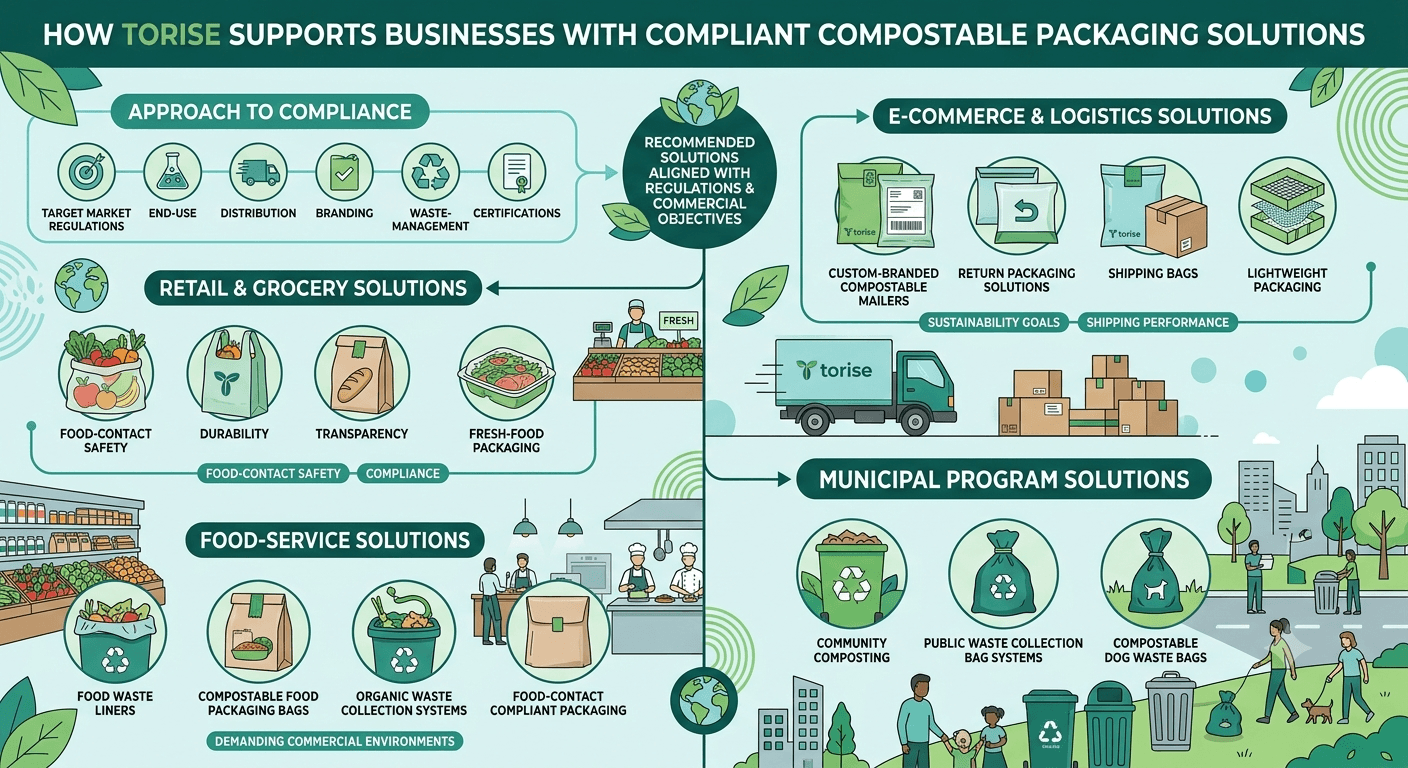
Retail & Grocery Solutions
E-commerce & Logistics Solutions
Food-Service Solutions
Municipal Program Solutions
Beyond Products: A Full-Stack Compostable Packaging Solution
Material Engineering
Structural Engineering
Branding & Private Label Development
Global Compliance Support
Procurement FAQ: Choosing the Right Compostable Packaging Solution
Looking Ahead
References