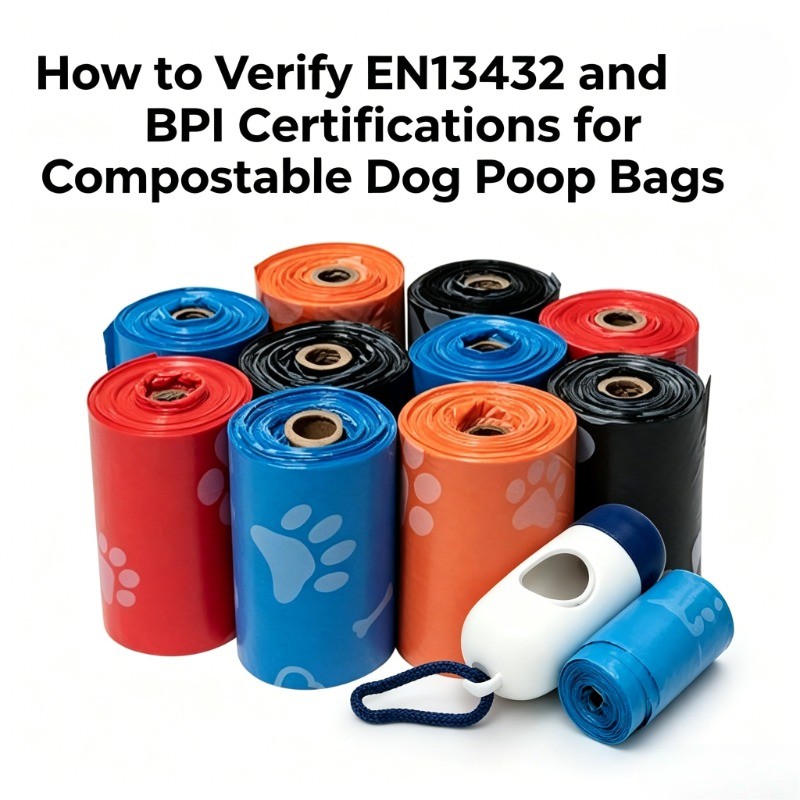
As demand for Compostable Dog Poop Bags continues to grow across Europe, North America, and Australia, certification has become one of the most important purchasing criteria.
Many retailers now require proof of compostability before approving new products. Distributors increasingly request certification documents during supplier qualification. Private label brands face growing pressure to ensure environmental claims can withstand regulatory scrutiny.
Yet one uncomfortable reality remains:
Not all certifications presented by suppliers tell the full story.
Experienced buyers know that simply seeing an EN13432 or BPI logo on a product specification sheet does not automatically mean the product is certified, compliant, or suitable for market claims.
This guide explains how professional buyers verify compostability certifications, identify common red flags, and reduce sourcing risks when purchasing Compostable Dog Poop Bags.
Why Certification Verification Matters More Than Ever
Five years ago, many buyers viewed compostability certifications as a marketing advantage.
Today, they are often a market entry requirement.
Retailers, municipalities, distributors, and e-commerce platforms increasingly demand independently verified evidence that products meet recognized compostability standards.
At the same time, environmental marketing claims are facing greater scrutiny.
Regulators are paying closer attention to terms such as:
- Compostable
- Biodegradable
- Eco-Friendly
- Sustainable
- Plant-Based
Brands that cannot support these claims with valid certification may face legal challenges, retailer rejection, or reputational damage.
As a result, professional buyers no longer ask:
"Do you have a certificate?"
Instead, they ask:
"Can I verify that certificate?"
Understanding the Difference Between Standards and Certifications
One of the most common sources of confusion involves the difference between a standard and a certification.
These terms are often used interchangeably, but they are not the same.
EN13432 Is a Standard
EN13432 is the leading European standard for industrial compostable packaging.
It establishes requirements regarding:
- Biodegradation
- Disintegration during composting
- Heavy metal limitations
- Environmental safety
The standard defines what a compostable product must achieve.
It does not certify products by itself.
BPI Is a Certification Program
The Biodegradable Products Institute (BPI) operates one of North America's most recognized compostability certification programs.
BPI certification evaluates products against recognized compostability standards such as ASTM D6400.
In simple terms:
EN13432 = Standard
ASTM D6400 = Standard
BPI = Certification Program
Understanding this distinction helps buyers evaluate supplier claims more accurately.
The First Question Buyers Should Ask: Is the Certification for the Finished Product?
This is where many procurement mistakes begin.
Some suppliers provide:
- Resin certificates
- Raw material certificates
- Laboratory reports
and present them as proof that the finished dog poop bags are certified.
However, a certified raw material does not automatically make a certified finished product.
The manufacturing process matters.
Variables such as:
- Material formulation
- Additives
- Color masterbatch
- Printing inks
- Production parameters
can affect final compliance.
Professional buyers should always ask:
Is the finished Compostable Dog Poop Bag certified?
Not merely:
Are the raw materials certified?
This single question often separates experienced suppliers from inexperienced ones.
How to Verify EN13432 Certification
When a supplier claims EN13432 compliance, buyers should request:
- Certification number
- Issuing organization
- Certificate validity date
- Product scope
Pay close attention to product descriptions.
For example:
If the certificate covers:
"Compostable Film"
it may not necessarily cover:
"Printed Dog Poop Bags"
The certified product category should match the product being purchased.
Another important consideration is the certification body.
One of the most widely recognized certification organizations in Europe is DIN CERTCO.
DIN CERTCO certification is highly respected among European buyers because it provides independent third-party verification that products meet EN13432 requirements.
When reviewing documentation, buyers should confirm:
How to Verify BPI Certification
For North American buyers, BPI certification is often the first document requested.
Fortunately, verification is relatively straightforward.
Buyers should request:
- BPI certificate
- Product identification details
- Certification number
Then compare the information against publicly available certification records.
The most common warning signs include:
Expired Certificates
Certification periods are limited.
An expired certificate should not be treated as valid compliance.
Incorrect Product Names
Sometimes suppliers provide certificates covering different products.
The certificate should clearly correspond to the specific Compostable Dog Poop Bags being sourced.
Logo Usage Without Certification
Some suppliers display compostability logos in marketing materials despite lacking valid product certification.
Professional buyers always verify documentation rather than relying solely on packaging claims.
Red Flags Every Buyer Should Watch For
After reviewing hundreds of supplier qualification processes, several warning signs appear repeatedly.
Red Flag #1: Supplier Avoids Sharing Certificates
Reliable manufacturers typically provide certification documents promptly. Delays, excuses, or incomplete documentation should trigger additional investigation.
Red Flag #2: Only Material Certificates Are Available
Raw material certification is valuable. However, it is not a substitute for finished-product certification.
Red Flag #3: Certificates Are Close to Expiration
Buyers planning long-term supply agreements should verify that certifications remain valid throughout the contract period.
Red Flag #4: No Traceability System
Modern procurement increasingly requires traceability. Buyers should understand: material sources, production batches, quality control procedures. This is particularly important for private label programs.
Beyond Compostability: Certifications That Serious Buyers Also Evaluate
While EN13432 and BPI are essential, experienced buyers rarely stop there.
Supplier evaluation increasingly extends beyond compostability alone.
FSC Certification
For brands using paper packaging, cartons, or retail-ready displays, FSC certification helps demonstrate responsible sourcing of forest-based materials. Many retailers now prefer FSC-certified packaging as part of broader sustainability programs.
ISCC PLUS Certification
ISCC PLUS has become increasingly important for companies focused on supply chain transparency and circular economy initiatives. It provides traceability for sustainable and renewable raw materials throughout the supply chain. For buyers seeking stronger sustainability credentials, ISCC PLUS often serves as an additional layer of assurance.
BRC Certification
BRC certification demonstrates robust quality management and manufacturing controls. Although commonly associated with food packaging, many procurement teams view BRC certification as evidence of operational discipline and manufacturing consistency.
Why Verification Is About More Than Compliance
Many buyers focus on certification purely from a regulatory perspective.
However, certification verification also helps predict supplier reliability.
Manufacturers capable of maintaining multiple international certifications typically demonstrate stronger systems in areas such as:
- Quality control
- Documentation management
- Process consistency
- Traceability
- Continuous improvement
In other words, certification often reflects the maturity of the manufacturing organization itself.
Why Global Buyers Choose Torise for Compostable Dog Poop Bags
At Torise, certification is not treated as a marketing tool. It is integrated into our manufacturing and quality management processes.
As a dedicated Compostable Dog Poop Bags manufacturer, we support global distributors, retailers, importers, and private label pet brands with certified compostable packaging solutions.
Our strengths include:
International Certifications and Compliance
- EN13432 compliant products
- BPI certified solutions
- DIN CERTCO recognized compostability compliance
- FSC certified packaging options
- ISCC PLUS certified supply chain management
- BRC certified manufacturing systems
- Explore Our Certifications: https://www.torisegroup.com/certificate.htm
The certifications shown here are representative examples of our compliance portfolio.
For the latest certification status, product-specific certificates, or supporting documentation required for your project, please contact us for assistance.
Manufacturing Capabilities
- More than 14 years of packaging manufacturing experience
- Advanced film extrusion and bag converting facilities
- Strict incoming material inspection procedures
- Batch-level quality control systems
- Global export experience across Europe, North America, Oceania, and Asia
Private Label Support
- Custom printing
- Retail-ready packaging
- Multiple bag sizes and thicknesses
- Customized roll configurations
- Sustainable packaging solutions tailored to local market requirements
For professional buyers, certification verification is not simply about checking a document. It is about selecting a supplier capable of supporting long-term growth, protecting brand reputation, and delivering consistent product quality.
Final Thoughts
The safest way to purchase Compostable Dog Poop Bags is not to assume a certification is valid simply because it appears on a datasheet or product package.
Instead, buyers should verify:
In today's market, certification verification is no longer a compliance exercise. It is an essential procurement skill.
The brands that take verification seriously are often the same brands that avoid costly sourcing mistakes and build stronger long-term supplier partnerships.