Hot Dog Paper Bags Buying Guide: Materials, Coating & Custom Solutions
- Share
- publisher
- Rachel
- Issue Time
- May 20,2026
Summary
The right hot dog paper bag combines material science, coating technology, and branding design to deliver both performance and sustainability.
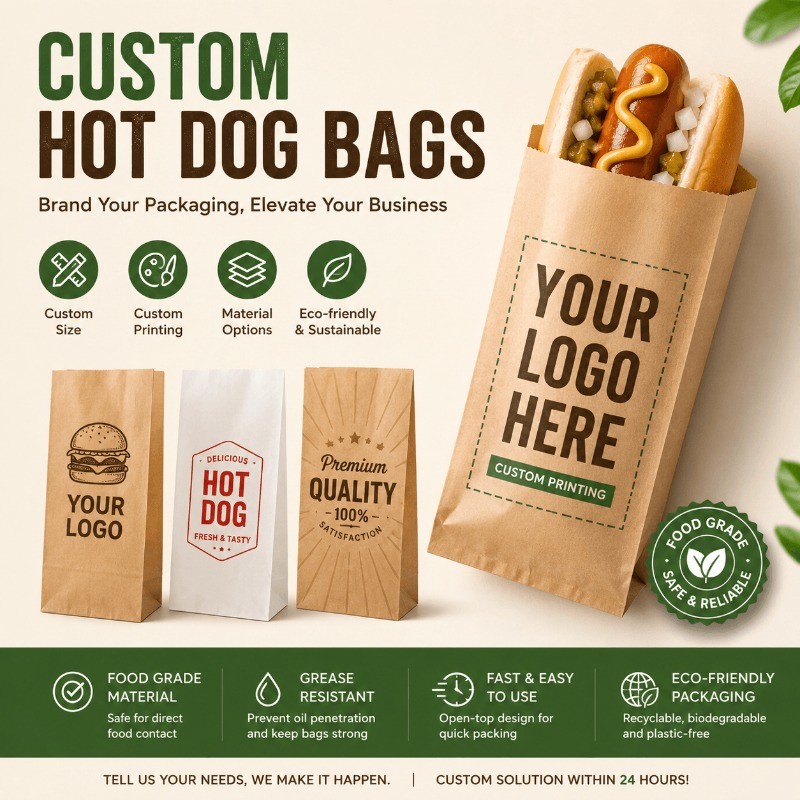
Whether you operate a high-volume QSR, a gourmet sausage brand, or a catering business, selecting the right food paper packaging—such as hot dog paper bags—is more than just a purchasing decision. It directly impacts food safety, customer experience, and your sustainability targets. This guide moves beyond generic sizing tips and delivers a structured sourcing framework focused on technical comparisons, buyer considerations, critical red flags, and special checkpoints for food paper bag procurement.
1. Technical comparison: Materials & functional coatings
Hot dog bags must resist grease, moisture, and heat while maintaining mechanical integrity. Below is a side-by-side comparison of the three dominant substrate + coating combinations used by professional suppliers.
| Material / Coating type | Key properties | Certifications / Limitations | Best for |
|---|---|---|---|
| Natural Kraft (uncoated) | High tear resistance, rustic brown look, porous; minimal grease resistance | Recyclable, FSC possible; not suitable for oily sausages or chili | Dry hot dogs, plain sausages, short holding time |
| Kraft + water-based acrylic / PLA dispersion | Good grease barrier (KIT rating 4-6), heat sealable, PFAS-free | Can be compostable if coating meets ASTM D6400; requires certified line | Most standard hot dogs, light toppings (ketchup, mustard) |
| Kraft + compostable biopolymer (PBAT/PLA blend) | Excellent grease & moisture barrier, fully compostable (industrial/home if specified) | BPI / TÜV OK compost; slightly higher cost; must be stored away from high humidity | Premium eco-positioned brands, chili cheese dogs, heavy sauces |
| Glassine / greaseproof paper (mechanical supercalendering) | Dense, translucent barrier without plastic; high grease resistance | Recyclable; limited compostability unless certified; less sturdy than kraft | Short-term wrapping, liners inside other bags |
*Request a KIT value from your supplier — level 4 or above for hot dog bags with mustard/chili; levels below 3 will leak within minutes.
2. Decision module: Buyer considerations (your sourcing checklist)
Volume & lead time
MOQ: 20k–50k pieces common for custom print. Express vs sea freight affects landed cost. Plan 30–45 days for full certification printing.
End-of-life infrastructure
If your local waste management accepts compostable packaging, prioritize BPI/OK compost. Otherwise, choose recyclable kraft to avoid greenwashing.
Print & branding
Flexo (up to 4 colors) or high-definition digital. Ensure inks are food-contact compliant (EU 2023/2006 or FDA).
Total cost of ownership
Cheaper uncoated bags may cause double-bagging (higher waste). Compostable bags often improve brand loyalty and justify premium pricing.
📌 Quick decision matrix
Prioritize compostable hot dog bags if your brand commits to plastic-free by 2027 or you operate in regions with plastic bag bans (Canada, EU, California). Choose standard greaseproof kraft if price is the main driver but you still need reliable oil holdout.
3. Common mistakes — avoid these sourcing pitfalls
❌ Mistake #1: Ignoring real-world grease test
Many buyers rely solely on spec sheets. Always perform a “5-minute hot dog test” with actual product (chili, cheese, sauerkraut). Soggy bottoms = angry customers.
❌ Mistake #2: Assuming “biodegradable” = compostable
Biodegradable bags might still leave microplastics; without EN13432/ASTM D6400 certification, they cannot be industrially composted, leading to greenwashing claims.
❌ Mistake #3: Overlooking storage conditions
Compostable coatings absorb moisture over time. Storing bags in humid warehouses weakens barrier performance. Demand sealed, climate‑controlled packaging from supplier.
❌ Mistake #4: Not verifying PFAS-free status
Fluorinated coatings provide grease resistance but are being banned globally. Ensure third-party test report confirms PFAS‑free, especially for food-contact paper.
👉 Why this matters for conversion: buyers who avoid these mistakes reduce product returns, protect brand reputation, and improve customer satisfaction — directly translating to repeat orders and higher margins.
4. Critical checkpoints for food paper bag buyers (industry insider)
- Food contact compliance: Supplier must provide a Declaration of Conformity (DoC) to FDA 21 CFR 176.170 (US) or EU Framework Regulation (EC) 1935/2004. Without this, you may be liable for chemical migration.
- Mineral oil hydrocarbon (MOH) control: Recycled paper may contain MOSH/MOAH from printing inks. Specialized virgin fiber or functional barrier layers are required for sensitive foods. Ask for migration test results.
- Heat resistance: Hot dog bags are often exposed to 80–90°C sausages. Coatings should not melt or transfer onto food. Verify heat-seal initiation temperature and blocking resistance.
- Printing ink safety: Solvent-free or low-migration inks are mandatory. UV-LED flexo inks are preferred for direct food contact surfaces (no migration through paper).
- Supplier audit rights: Reliable suppliers allow third-party audits of manufacturing hygiene and raw material traceability. A GMP or BRC certification is a strong plus.
📎 Many buyers skip these points and later face rejected shipments or regulatory fines. Use the button below to request a compliance package from qualified manufacturers.
*The link leads to Torise Group’s custom food paper bags: standard kraft paper bags & premium compostable greaseproof hot dog bags with full technical documentation.
Summary: Build a procurement strategy that works
A professional hot dog bag is not a commodity — it’s an engineered component of your food service operation. Focus first on the coating & certification (compostable vs. recyclable), then verify food safety documentation, and finally test with real product. Integrate the decision framework above to align budget, performance, and sustainability goals.
Still unsure which technical specification fits your hot dog line? Reach out to specialists who can provide material samples, KIT test data, and certificate packages. The right supplier will guide you through coating selection, print design, and compliance checklists without hidden fees.
Need a compliance package, material samples or a custom quote? One click – we’ll reach out within 24h with full details (coating & pricing).