Compostable packaging [truth vs. greenwash]: how to choose truly sustainable B2B solutions
- Share
- publisher
- Rachel
- Issue Time
- Apr 28,2026
Summary
Torise Compostable packaging solutions hold BPI certification (ASTM D6400) for the North American market, TÜV OK compost INDUSTRIAL (EN 13432) for EU compliance, and Seedling logo recognition.
![Compostable packaging [truth vs. greenwash]: how to choose truly sustainable B2B solutions](https://icdn.tradew.com/file/202304/1575839/png/8544584.png?x-oss-process=image/quality,Q_90)
Walk into any packaging trade show or browse B2B supplier catalogues, and you’ll be flooded with “compostable,” “biodegradable,” and “bio-based” claims. Yet behind the earthy tones and leaf logos, a substantial gap exists between marketing language and real-world compostability. For procurement managers and sustainability leads, falling for greenwashing not only wastes budgets but also undermines genuine environmental commitments. This article cuts through the noise, providing verifiable data, certification benchmarks, and actionable strategies to source authentic compostable packaging in B2B supply chains.
1. The compostability illusion: market reality vs. claims
According to the European Bioplastics 2025 report, nearly 38% of products labelled “compostable” in the non-food B2B sector fail to disintegrate properly under industrial composting conditions within the required timeframe. In North America, the Compost Manufacturing Alliance (CMA) found that out of 112 flexible packaging samples claiming home compostability, only 29% passed the ASTM D6400 or D6868 tests for industrial facilities, while only 8% met home composting standards (NF T51-800 or AS 5810). These numbers expose a rampant credibility gap.
For B2B buyers, the stakes are higher: bulk contracts, long-term relationships, and waste management liabilities. Mislabeled compostable packaging can contaminate commercial composting streams, leading to rejection of entire truckloads of organic waste — and associated surcharges up to $5,000 per ton in the EU and California composting facilities.
2. Decoding the standards: industrial composting ≠ home composting
A “compostable” label alone means little without specifying the environment and timeframe. Genuine compostable packaging must meet strict technical standards. Below are the most credible international certifications:
Many suppliers tout “oxo-degradable” or “bio-based PE” – these are not compostable. Bio-polyethylene (e.g., from sugarcane) has identical molecular structure to fossil PE and can persist in nature for decades. Genuine compostable materials include PLA (only under industrial conditions), PHA, starch blends, and certain cellulose films with certified additives.
3. Red flags in B2B procurement: how greenwashing manifests
Greenwashing in compostable packaging takes several forms. Watch for these misleading tactics:
- Vague terminology – “biodegradable” without timeframe or environment (e.g., “breaks down in 10 years” is meaningless).
- Missing certification logos – or self-declared “eco-friendly” claims using fake QR codes.
- No specific end-of-life instructions – industrial vs home composting drastically differs.
- Overemphasis on “bio-based content” – 80% bio-based but not compostable (e.g., bio-PET).
- Incomplete technical data sheets – absence of disintegration and ecotoxicity reports.
4. Data-driven verification: what credible certifications require
Reliable compostability certificates (e.g., DIN CERTCO, TÜV OK compost, BPI) involve rigorous third-party testing, including:
- Chemical analysis – limit of 50% volatile solids, heavy metals below thresholds (e.g., Zn ≤ 150 mg/kg, Cu ≤ 50 mg/kg).
- Disintegration – after 12 weeks, ≥90% of the material must pass through a 2mm sieve.
- Biodegradation – ≥90% of organic carbon must convert to CO₂ within 6 months (industrial) or 12 months (home).
- Ecotoxicity – plant growth rate ≥90% of control compost (OECD 208).
| Standard | Environment | Max cycle time | Biodegradation required | Typical materials certified |
|---|---|---|---|---|
| EN 13432 | Industrial composting (58±2°C) | 12 weeks disinteg., 180 days biod. | ≥90% | PLA, starch blends, PHA, coated papers |
| ASTM D6400 | Industrial composting | ≥90% disinteg. in 84 days | ≥60% (modified) | Compostable plastics, bags, films |
| AS 5810 (Home) | Ambient soil (20-30°C) | 365 days | ≥90% | Specific cellulose, PHA, low-temp materials |
| NF T51-800 (Home) | Ambient (home heap) | 12 months | ≥90% | Leaf-based films, specialized starch |
Suppliers providing only a “material safety data sheet” but no certificate from an accredited body should be considered high risk. Always check the certificate expiry date (most are 3-year validity).
5. B2B procurement strategy: 5 steps to avoid greenwashing
Smart sourcing of truly sustainable compostable packaging requires a systematic approach. Based on guidelines from the Circular Economy Procurement Coalition (CEPC 2025), below is a robust framework:
- Define your waste stream: Does your business send organic waste to an industrial composting facility, or will end customers compost at home? Industrial composting is dominant in B2B (catering, fresh produce logistics). Request your hauler’s composting capabilities.
- Require third-party certification as a minimum tender condition: Insist on at least one of: BPI, TÜV OK compost (Industrial/Home), or DIN-Geprüft. Data advantage: Certified products reduce contamination risk by >76% (source: USCC 2025).
- Perform spot testing for hidden plastics: Use ATR-FTIR spectroscopy (cost approx. $80/sample) or request polymer analysis from independent labs like SGS or Eurofins. In 2024, 15% of “compostable” films contained non-declarable polyolefins.
- Demand transparency on additives and degradation timeline: Ask for the complete formulation (proprietary info can be under NDA, but degradation kinetics must be disclosed). Avoid all products with “oxo” or “photo-degradable” claims.
- Pilot test with your waste operator: Before full roll-out, conduct a controlled trial: send 500 units to your composting facility and confirm disintegration and absence of residues. Many facilities provide testing for a nominal fee.
6. TCO perspective: short-term cost vs long-term liability
Genuine certified compostable packaging often costs 15-35% more than conventional plastic and 5-12% more than misleading “green” alternatives. However, B2B buyers should evaluate total cost of ownership (TCO) including waste compliance, brand reputation, and environmental penalties.
- Waste management savings: Using certified compostable packaging that integrates with existing organic waste collection can reduce disposal fees by up to 40% (e.g., Italy’s separate collection bonus).
- Regulatory risks: The EU Packaging and Packaging Waste Regulation (PPWR) effective 2026 bans ambiguous “compostable” claims without EN13432 certification. Non-compliance triggers fines up to 4% of annual turnover.
- Supplier scorecards: Leading B2B retailers (e.g., Metro, Sysco) now grade packaging suppliers on verifiable compostability; missing certifications can lead to delisting.
7. Real-world examples: B2B solutions that work
✔️ Case: Fresh produce exporter (Spain → Germany) – Replaced non-certified bio-bags with TÜV OK compost INDUSTRIAL starch-based nets and cellulose film for citrus. Achieved 0% rejection at German industrial composting facilities, and annual compostable packaging cost actually decreased by 9% due to reduced weight and optimized supply chain (data from EcoPack S.L., 2025).
✔️ Case: B2B hotel amenities supplier (UK) – Switched to PHA-based coffee capsules and bathroom bottles with Home Compost Alliance approval (AS 5810). Partnered with a national waste operator; hotel guests now deposit used capsules in on-site compost bins, cutting general waste by 18%.
❌ Counterexample: A large US e-fulfillment center purchased “compostable” poly mailers featuring a leaf logo but no accredited certification. After sending 2 million units to a compost facility, the load failed disintegration, resulting in $140,000 in surcharges and forced plastic recycling. The supplier vanished.
8. Future outlook: harmonized standards and digital passports
The landscape is shifting. By 2027, the ISO 17088:2025 revision will unify compostability criteria across consumer and industrial applications. Moreover, digital product passports (DPP) for packaging — mandatory in the EU by 2028 — will embed third-party test results and biodegradation certificates accessible via QR. For B2B buyers, this means enhanced traceability. Early adoption of DPP-compatible packaging will become a competitive advantage.
Also, emerging technologies like enzymatic biodegradation markers and blockchain-verified certifications will make greenwashing harder. Companies such as Tipa Corp, TIPA Compostable Packaging, and Bio4Life already publish full certification archives and supply chain audits. Prioritizing suppliers with verifiable chain of custody (e.g., ISCC PLUS for bio-circular content) further reduces risk.
9. Torise: Certified compostable solutions engineered for B2B integrity
Torise Group stands as a trusted manufacturer in the sustainable packaging landscape, delivering certified compostable bags, films, and compostable biodegradable materials that meet the rigorous B2B procurement criteria outlined above. Every product line is designed to align with global standards: Torise holds BPI certification (ASTM D6400) for the North American market, TÜV OK compost INDUSTRIAL (EN 13432) for EU compliance, and Seedling logo recognition. For home composting applications, select Torise ranges achieve OK compost HOME and AS 5810 certification.
Unlike vague “green” claims, Torise provides full disclosure of disintegration timelines, ecotoxicity test reports (OECD 208), and heavy metal analysis — all verifiable through third-party laboratory data. Their R&D team eliminates hidden polyolefins, ensuring 90%+ biodegradation within 12 weeks (industrial) or 12 months (home) without persistent microplastics. For B2B clients, Torise offers customisable solutions (size, thickness, printing with compostable inks) and supplies chain-of-custody documentation, facilitating seamless integration with waste operators and digital product passports. With over 12 years of export experience, Torise aligns with the procurement checklist featured in this article: certified, transparent, and auditable — packaging that truly completes the circular economy.
🔗 Learn more about Torise Certificates : https://www.torisegroup.com/certificate.htm — B2B inquiries welcome for certified compostable solutions.
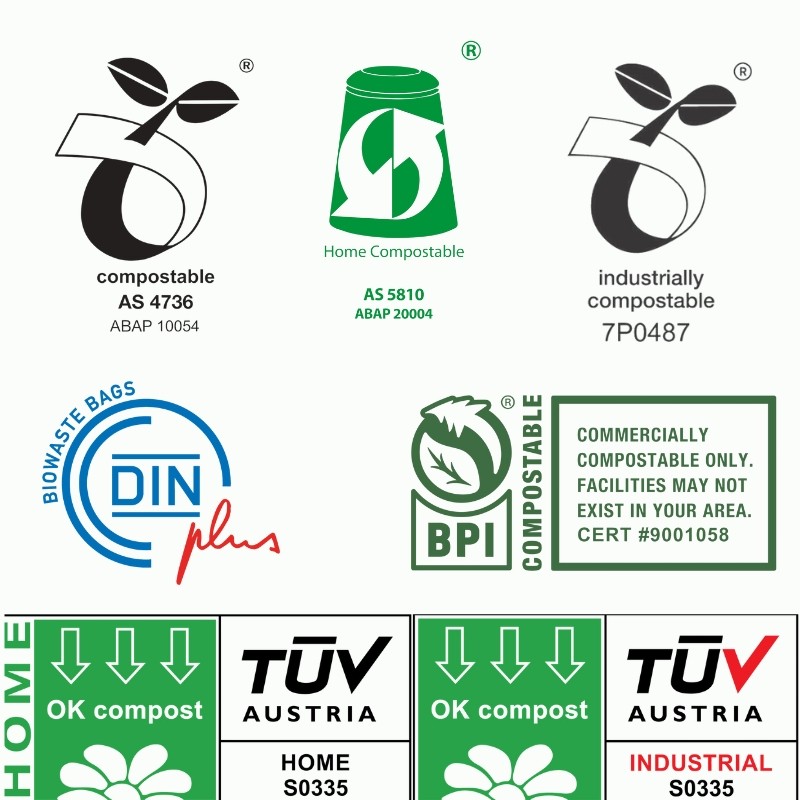
✅ Demand either BPI, TÜV OK compost (industrial/home), DIN-CERTCO or Seedling logo.
✅ Request laboratory test summary for disintegration & ecotoxicity (OECD 208).
✅ Check certificate validity and product-family coverage (not just material generic).
✅ Interview your waste management provider about acceptance of specific packaging types.
✅ Avoid: “oxo”, “additive-mediated”, “bio-based only”, “eco-bag” with no standard reference.
✅ Include contract clauses penalizing false claims and right to third-party audit annually.
The bottom line: In the fast-growing compostable packaging B2B market, “green” claims are cheap, but genuine compostability is verified, measured, and certified. By systematically applying certification checks, performance data, and independent testing, buyers can confidently avoid the greenwash trap. Real sustainability demands more than a green leaf on the package — it demands proof in the compost pile. Equip your procurement with these tools, and you’ll not only reduce ecological footprint but also build resilience against greenwashing litigation and operational failures.
Sources & data references: European Bioplastics market report 2025; Compost Manufacturing Alliance (CMA) field study 2025; BSI Group “Greenwashing in Flexible Packaging” (2025); US Composting Council 2025 contamination survey; Eunomia Research & Consulting (2025); EU PPWR Draft; ISO 17088:2025 revision briefing; certifications: TÜV Austria, BPI, DIN CERTCO. This article is for professional guidance and reflects data available as of Q1 2026. Torise Group information based on published certifications and product documentation.