Biodegradable Packaging Regulations: What Buyers and Suppliers Need to Know
- Share
- publisher
- Rachel
- Issue Time
- Sep 24,2026
Summary
Learn the 2026 compostable biodegradable packaging key regulations, standards, certifications, and compliance requirements in the EU, US, and Australia.
Biodegradable Packaging Regulations: What Buyers and Suppliers Need to Know
“Biodegradable packaging” sounds simple.
A bag breaks down after disposal, so it should be environmentally friendly—and therefore compliant, right?
Not necessarily.
For packaging buyers, especially those sourcing
compostable raw resins, custom compostable bags, paper bags, food accessories, and compostable stretch films,
biodegradability is only one part of the compliance picture.
A packaging product may be biodegradable but not certified compostable.
It may be compostable but still require additional chemical compliance testing.
And an environmental claim that is acceptable in one market may require different evidence in another.
For suppliers selling into Europe, the United States, Australia, and other developed markets,
the real question is not simply:
It is:
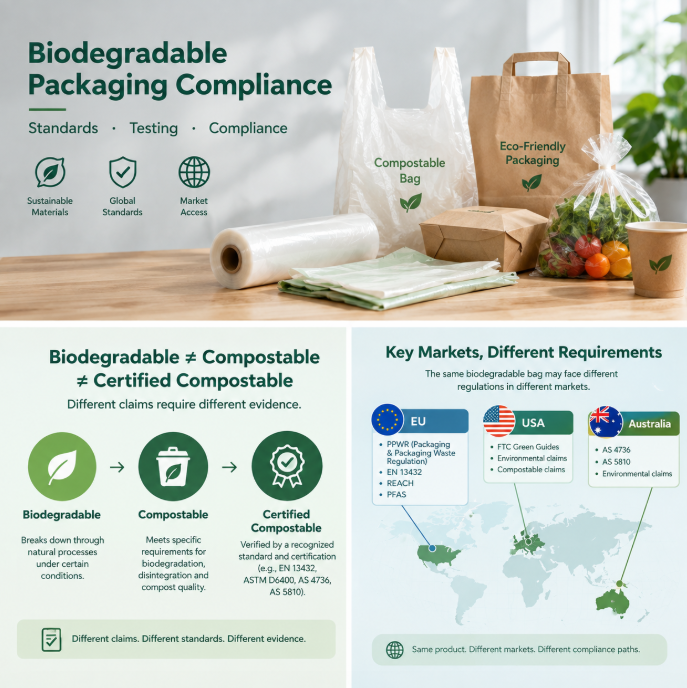
One of the first distinctions buyers should understand is the difference between
biodegradable and compostable.
Biodegradable materials can break down through biological processes under particular environmental conditions.
However, the speed and conditions of degradation can vary significantly.
Compostable packaging has a more specific meaning.
Depending on the applicable standard and certification, the packaging may need to demonstrate requirements related to:
This means that a supplier should not automatically use:
as if these terms were interchangeable.
They are not.
For buyers, the most useful question is therefore not simply
“Is it biodegradable?”,
but:
There is no single global regulation called the “Biodegradable Packaging Regulation.”
Requirements depend on several factors:
A food-contact compostable bag, for example, can face a different compliance path from
a general-purpose biodegradable waste bag.
For international packaging suppliers, three markets are particularly important:
the European Union, United States, and Australia.
For companies selling packaging into Europe, the
Packaging and Packaging Waste Regulation (EU) 2025/40,
commonly referred to as PPWR, is now a central piece of the regulatory framework.
PPWR covers much more than whether a package can biodegrade.
It addresses areas including:
This is important because a supplier cannot simply use a “biodegradable” claim
as a substitute for demonstrating compliance with the applicable packaging requirements.
For certain packaging applications, PPWR introduces requirements concerning compostability.
The regulation also distinguishes between packaging that is required or permitted to be compostable
and other packaging that needs to follow the applicable material-recycling requirements.
The intended application matters.
For suppliers of compostable bags and films, this makes certification and technical documentation increasingly important.
When discussing compostable packaging in Europe, EN 13432
is one of the standards buyers commonly encounter.
It establishes requirements for packaging that is intended to be recovered through
industrial composting and biodegradation.
A compliant compostable packaging product needs more than a statement that the raw material is biodegradable.
The relevant requirements concern the packaging product and its behavior under the specified testing conditions.
This distinction matters in procurement.
For example, a supplier may use PLA, PBAT, starch, or a combination of materials.
But the buyer should still ask:
Another important change in packaging procurement is that sustainability claims are no longer the entire conversation.
European buyers increasingly look at the chemical composition of packaging as well.
Depending on the product and market, suppliers may need to consider requirements involving:
Packaging may be subject to restrictions concerning certain heavy metals.
Per- and polyfluoroalkyl substances have become an increasingly important issue for packaging manufacturers
and buyers, particularly for food-related applications.
The EU REACH framework can be relevant to substances used in packaging materials,
including substances of very high concern (SVHC).
For serious B2B procurement, these should therefore be treated as different compliance questions.
If the packaging is intended to directly contact food, environmental compliance is only one part of the process.
For example, a food packaging buyer may need documentation covering:
This is why a supplier's certificate list should not simply be a collection of environmental logos.
The regulatory approach in the United States is somewhat different.
The Federal Trade Commission (FTC) provides guidance on environmental marketing claims
through its Green Guides.
One important principle is that broad environmental claims need appropriate substantiation.
For example, an unqualified “biodegradable” claim can be problematic if the product does not completely break down
within the timeframe and disposal conditions consumers would reasonably expect.
Compostable claims also need appropriate evidence.
If a product can only be composted under industrial composting conditions,
the marketing claim should not create the impression that consumers can simply put it into a backyard compost pile.
This is particularly relevant for flexible packaging.
Instead of making a broad statement such as:
a more technically meaningful claim would identify the actual characteristic and supporting standard or certification.
The exact claim should always match the evidence available for the finished product.
Australia takes a similar approach to environmental marketing claims.
Under Australian consumer protection law, businesses need to ensure that environmental and sustainability representations
are truthful, accurate, and supported by reasonable grounds.
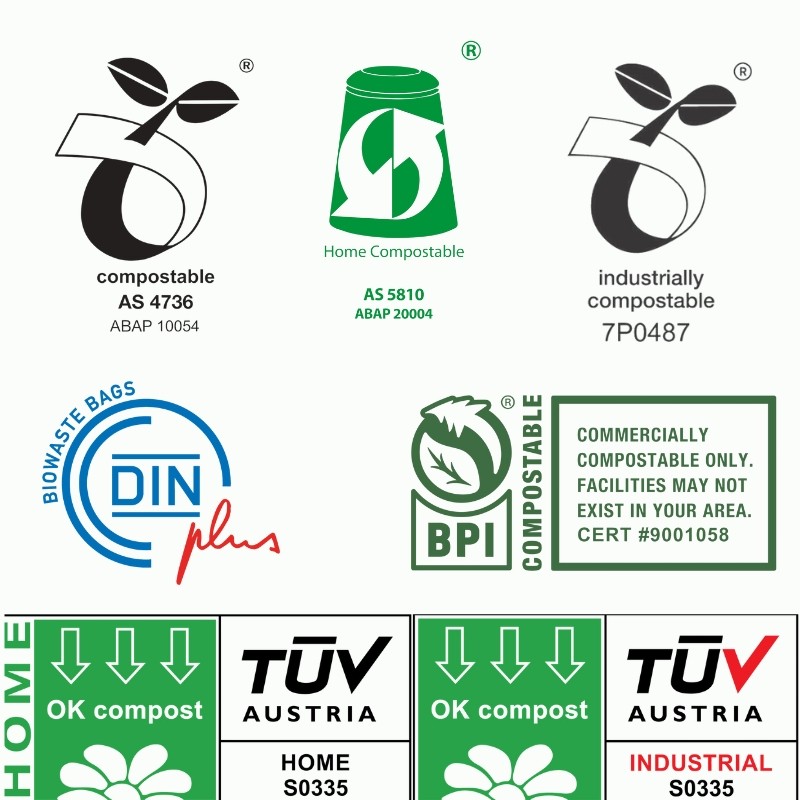
For compostable plastics, buyers may also encounter standards such as:
The important point is again the same:
Industrial composting and home composting are not automatically interchangeable.
If a product is certified for industrial composting, that does not by itself mean that the product
should be marketed as suitable for home composting.
Is it:
Do not treat these as interchangeable.
Ask for the applicable standard, not just a generic “eco-friendly certificate.”
The appropriate standard depends on the product and target market.
This is an important question.
A raw material certificate does not necessarily prove that the final bag—with printing ink,
adhesive, zipper, coating, and other components—is covered.
Depending on the destination market and application, buyers may request documentation related to:
Ask specifically:
A product designed for industrial composting should not automatically be marketed as suitable
for home composting or ordinary landfill disposal.
For international B2B buyers, a useful compliance package should go beyond a certificate displayed on a website.
→ Material composition
→ Compostability certification
→ Heavy metal testing
→ Applicable food-contact testing
→ ISO certifications
The exact documentation depends on the product and destination market.
For packaging buyers, certification should answer a practical question.
Not:
A certificate does not prove everything.
It proves what its scope and test requirements cover.
That is why experienced packaging buyers look at the
document, scope, product, test method, and validity period,
rather than simply the logo.
The packaging market is moving away from simple claims such as:
The reality is more specific.
A modern biodegradable or compostable packaging product may need to satisfy several different layers:
This is especially important for brands, retailers, e-commerce sellers, distributors,
and food packaging importers.
The most reliable procurement approach is therefore to start with the
target market and intended application,
then determine which standards, tests, certifications, and supporting documents are actually required.
“Biodegradable packaging” is not a single regulatory category.
The compliance requirements depend on
what the packaging is made from, what it is designed to do,
where it will be sold, how it will be disposed of,
whether it contacts food, and what environmental claims are made about it.
For European buyers,
PPWR, compostability requirements, chemical restrictions,
and food-contact requirements
can all become relevant.
For US buyers,
substantiation of environmental claims
is particularly important.
For Australian buyers,
environmental claims and applicable compostability standards
also need careful attention.
For suppliers, the safest approach is simple:
That is what turns a “biodegradable bag” from a marketing concept
into a product that can be evaluated properly for international B2B procurement.
“Is this packaging biodegradable?”
“Can we prove that the material, finished packaging, environmental claims,
and intended disposal method meet the requirements of the target market?”
1. Biodegradable Does Not Automatically Mean Compostable
“Under what conditions does it biodegrade, and what standard or certification supports that claim?”
2. What Regulations Apply to Biodegradable Packaging?
3. European Union: PPWR Changes the Compliance Conversation
Compostability under the EU framework
Being biodegradable does not automatically determine the regulatory route for the packaging.
4. EN 13432: Why European Buyers Often Ask About It
Buying a “compostable material” does not necessarily mean buying a certified compostable finished package.
5. Environmental Compliance Is Also Chemical Compliance
Heavy metals
PFAS
REACH
A product can pass a compostability test and still require separate chemical compliance assessment.
6. What About Food-Contact Packaging?
+
Food-contact requirements
+
Chemical restrictions
+
Product performance requirements
Does the documentation actually cover the product I am purchasing and the market where I intend to sell it?
7. United States: Be Careful With “Biodegradable” Claims
8. Australia: Claims Must Also Be Supported
The disposal environment matters.
9. What Should a Packaging Buyer Ask a Supplier?
1. What exactly is the product claim?
2. What standard supports the claim?
3. Does the certificate cover the finished product?
4. What chemical compliance documents are available?
5. What happens after disposal?
Where is the product expected to be disposed of?
10. What Should a Responsible Packaging Supplier Provide?
Product Specification
→ Thickness
→ Dimensions
→ Mechanical properties
→ Temperature range
→ Sealing / leakage performance
Environmental Documentation
→ Applicable testing reports
→ Relevant standards
Chemical Compliance
→ PFAS testing where relevant
→ REACH / SVHC documentation
Food-Contact Documentation
→ Declaration or supporting documentation
→ Migration information where applicable
Manufacturing and Quality Documentation
→ Factory audit documentation
→ Quality-control records
→ Batch or production traceability where applicable
11. The Biggest Mistake: Treating Certification as a Marketing Logo
“What requirement does this document prove?”
“How many logos does this supplier have?”
Documentation
What It Can Help Demonstrate
EN 13432 certification
Compostability requirements under the applicable standard
ASTM D6400
Compostability requirements under the applicable ASTM standard
AS 4736
Commercial/industrial compostability in the applicable Australian framework
AS 5810
Home compostability in the applicable Australian framework
REACH / SVHC documentation
Substance compliance information
PFAS test report
PFAS-related testing results
Heavy metal test
Results for specified metals
Food-contact documentation
Suitability/compliance for the intended food-contact application
ISO 9001
Quality management system
Factory audit
Social/ethical or supplier assessment, depending on the audit scope
12. What This Means for Biodegradable Packaging Buyers in 2026
Final Takeaway
Make specific claims, test the finished product, maintain documentation,
and match every claim to the market and standard it actually supports.